Emma Dewey Allred Hayward
Mary Ann was the wife of Cyrus Wheelock who was Pioneer of the Month,
August 1, 2008. Not much was said about his wife Mary Ann. So now we can
learn more.
![]() |
| Mary Ann Dallin Wheelock |
The four oldest brothers of the Dallin family, John, William, Thomas, and Robert, sailed on the “North Atlantic” from Liverpool on 4 September and arrived in New Orleans on 1 November 1850. Evidence from genealogical records suggests that the brothers traveled to the Salt Lake Valley in 1851. However, further research is needed to determine the exact company they traveled with.
The rest of the Dallin family traveled to the Salt Lake Valley in 1852 with the Abraham O. Smoot Company.
The brother’s father, Tobias, and the rest of their siblings, Mary Ann, Catherine, Eliza, and Edwin, sailed from Liverpool on the “Ellen Maria” on 10 February, and arrived in New Orleans on 5 April 1852.
Mary Ann's birth and death dates are confirmed by the Utah State History Cemeteries and Burials Database and Find A Grave website.
Mary Ann married Cyrus Hubbard Wheelock on December 11, 1853. They were the parents of seven children and they were living in Springville, Utah.
They moved to Mt. Pleasant, Utah December 1863. Then they moved to North Ogden where Cyrus was called to be a bishop. At this time Mary Ann taught school. Then they moved back to Mt. Pleasant.
Mary Ann was a small woman, but a woman of strength, as was displayed in the many trials of endurance faced in her life. She had a keen mind. She was able to discern, foresee, and counsel family and friends. Her husband traveled a lot making life difficult and lonely at times.
Mary Ann passed away on March 13, 1892, in Mt. Pleasant at the age of sixty-one.
![]() |
| Tabias Dallin Father of Mary Ann Dallin |
![]() |
| Marian Dallin Wheelock Grave Marker |
Andrew Johansen, the fifth son and seventh child of Niels and Ane Andersen Johansen, was born on 26 November 1870 at "The Bottoms," an area located a little west of Mt. Pleasant, Sanpete, Utah. His father lived the then-prevailing church law of polygamy and had two sisters, Ane and Andersina Andersen for his wives. Ane, Andrew's mother, lived on a farm at the Bottoms while Andersine (or Sena) and her children lived in Mt. Pleasant. Andrew did not receive too much early schooling perhaps because of the distance to school or perhaps because he was needed to help on the farm. Although he was the fifth son, two boys had died while very young, and the oldest (Joseph) had married when Andrew was only seven years old; this left just Andrew and John to help on the farm and assume responsibilities when their father was not at home. When Andrew was fifteen his mother died. She left her husband and a family of six living children.. Living just a few miles north of Niels Johansen's farm was another Danish convert and his family. Mons and Maren Katherine Pallesen (Jensen) Monsen had come from Denmark in 1879. Their oldest child, Annie, along with one brother had been born in Denmark. (The Monsens later had five additional children.) Andrew began "courting" Annie Monsen--taking her horseback riding, to the local dances and to church parties. Two days before Andrew's twenty-first birthday they went to the Manti Temple to be married. After their marriage, Andrew and Annie purchased a farm on the Bottoms, but later acquired a home in Mt. Pleasant. In addition to farming, Andrew spent some time during their early married life herding sheep in Scipio. They lived in Mt. Pleasant for seventeen years and during this time Annie gave birth to six children: Fredrick Leo 10 February 1893; Andrew Orange 2 April 1896; Vienna 4 November 1899; Arda May 5 April 1901; Mons Neldon 1 April 1904; Ada Arvinna 2 January 1907. Two of the girls, Vienna and Arda May, passed away during this period and are buried in Mt. Pleasant. Vienna was just a little over four months old when she died of whooping cough and Arda May had heart trouble and passed away at the age of three. In 1908 they heard of some land in the Uintah Basin that could be obtained if a person made the proper filing and then homesteaded it, continuing the necessary improvements. Andrew and his brother-in-law, Will Oman, (married to Andrew's younger sister, Annie) decided to investigate and they later filed on some land in Boneta, a community fifteen miles north of Duchesne, the county seat of Duchesne County. The two men left in the late winter or early spring for Boneta and built homes for their families. In April they returned to Mt. Pleasant for their families and traveled to Colton and thence to the "Basin." Their first home in Boneta was a one-room log cabin with a sod roof, dirt floor, and no windows. (It was located under the hill from their later large family home.) Conditions were very similar to those of the early pioneers of Salt Lake Valley. Sagebrush had to be burned and land cleared before any planting could be done. Some other settlers from Sanpete also joined them at about the same time. There was no water so they had to haul it in. In the winter they melted snow. Then the men all went up to the Lake Fork River and made a canal. Even with the canal and new ditches, many areas were quite a distance from water and still had to haul it to their homes. Because of Indian treaties, Indians had priority on water rights and the settlers worked hard with their crops and meager water privileges. However, the Lord was sure with them and while Andrew didn't become a rich man of gold or silver, he did raise a posterity to honor his name. During this hard period of homesteading, there were few, if any, serious illnesses in his family. (Among his posterity three descendants are named after him: Andrew Orange Johansen, a son; Donald Andrew Johansen, a grandson; and Donald Andrew Johansen, Jr., a great-grandson.) In 1911, Annie returned to Mt. Pleasant for the winter to await the birth of their seventh child. Leo had stayed in Boneta with his father and the other children accompanied their mother. On 25 February 1911 their last child, Mary Catherine, was born. They first had a school in Boneta which also served as the church meeting place; later a chapel was built. At this time Andrew built a "townhouse" near the church and school for winter living and in the spring and summer, they moved to their farmhouse under the hill. Finally about eight or ten years after they had arrived in Boneta, they built a lovely four-room ranch house on a flat overlooking the surrounding area, and it was here Andrew spent the remaining years of his life. Annie's brother, Orson Monsen's wife died in 1925 after giving birth to a baby boy. Andrew and Annie took the baby, Frank Monsen, into their home and loved and raised him as their own. Andrew and Annie sent one son, Andrew Orange, on a mission and helped their other children in establishing their own homes. Andrew was generous with what he had although he was very quiet. The following obituary was published at the time of his death: "Andrew Johansen, 68, one of Bonet'a earliest settlers, died suddenly at his home Sunday, July 23, 1939, at 4:15 P.M. ...Mr. Johansen had been suffering for several months from a serious heart ailment, but though he and his family had been warned his condition was serious, it was not expected that the end would come so soon. Sunday morning his son, Andrew Orange Johansen, of Logan, had arrived at the home and had suggested that his father and mother accompany him to Logan for a visit. Mr. Johansen seemed in good spirits and health as he prepared for the journey and all the members of his family were present to bid him goodbye as he left the house and entered his son's car. The car, with orange and his mother in the front seat and Mr. Johansen in the rear, had hardly traveled 100 yards when Mr. Johansen made some strange sounds that attracted his son's attention, and before the car could be brought to a halt he toppled over in the seat. Death apparently came almost instantly and the goodbyes Mr. Johansen had just given his family served as a goodbye for all time... Although a staunch L.D.S., Mr. Johansen never made any effort to push into the limelight in church work or otherwise. he was known by all his neighbors and friends as a quiet man with little to say, but one who was always a good neighbor, ready and willing to take the share of all responsibilities and cares. he was loved and respected by the entire community." Andrew's appearance was one of premature aging almost certainly coming from the hard pioneering work on his farm in Boneta. he carried the same appearance for years and never seemed to age any further than the first time you met him. He was a quiet hard-working man who never complained or spoke ill of anyone. His visits were always a treat to the grandchildren, and on one such visit, they brought a beautiful Christmas baby doll to their granddaughter, which she still treasures and holds dear. Andrew today (1968) has a posterity of 83; these and many other people will remember and hold dear the memory of Andrew Johansen. Story submitted by Beverly Johansen Edvalson. (Beverly originally began compiling the Niels Johansen Family Record, then asked if I would take over. She deserves our thanks for her foresight.)
Carl Gustave Bjelke, son of Niels and Catherine was born in Malmo Sweden December 13, 1823. He learned the trade of shoemakers. He joined the Latter Day Saint Church in 1857 and immigrated to Utah in 1861, crossing the plains in an ox train under Captain Murdock.
After residing in Salt Lake for one year he came to Mt. Pleasant in 1862 and worked at his trade and on a farm.
When he landed in New York he had just 50 cents left and he gave that to a Danish emigrant whose wife and baby was ill.
He was the only one in his family to come to this country except for a cousin by the name Streeper whose posterity is living in Davis County.
He lived in the fort the first winter and the next winter he had a shop where the Texico Service Station now stands (no longer).
Anthon H. Lund who later became prominent in the Church lived here with him during the winter.
He served 3 and 1/2 years in the mission field in the old country before coming here and was the means of converting several families to the Gospel, who then came to Utah and were located in Fairview and Moroni.
Mr. Bjelke was married to Mary Wall in the fall of 63. Seven children were born to them and four of them passed away in infancy.
The couple moved to Moroni in 1866. That was the year the Black Hawk War was an uprising. The subject of this sketch is Captain Swenson Company.
After spending years in Moroni, they moved back to Mt. Pleasant where they resided ever since.
After coming back to Mt. Pleasant Mr. Bjelke worked with four other shoemakers: Hafen, Hendricksen, Nielsen and Omen to make shoes for the growing community.
He was one of the companies that built the amusement hall which was afterward sold to Duncan McMillan and became the Wasatch Academy and later the First Presbyterian Church.
He was also one of the first stockholders of the Snpete Coop in business 58 years.
Mr. Bjelke died in December of his 85th year. He belonged to the Kings Hussars while in Sweden
(1823 to 1909)
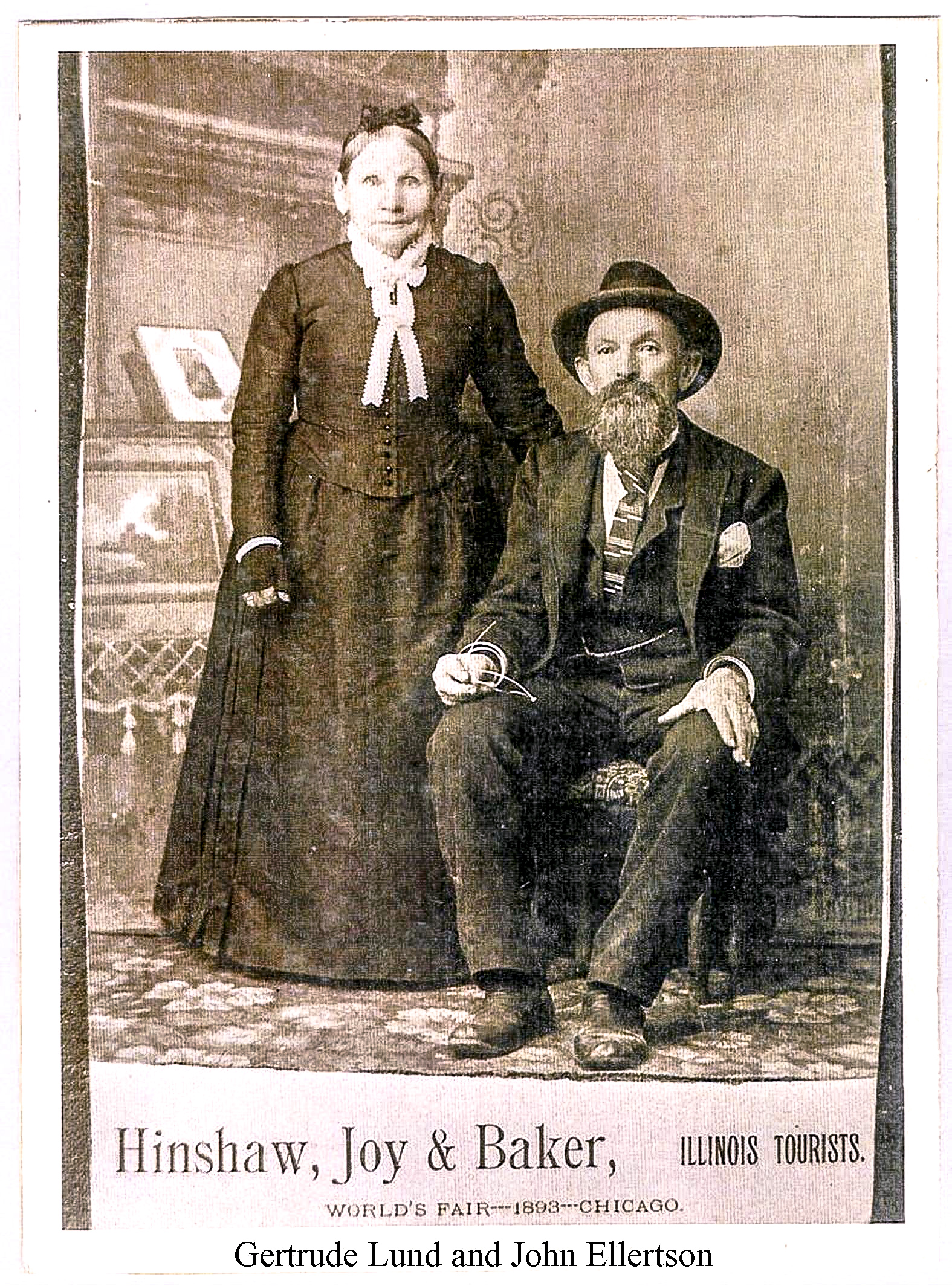
HISTORY OF JOHN EILERTSEN & GERTRUDE CHRISTENA LUND
by Ephraim Ellertsen
John Eilertsen was born on 13 September 1823 in Carlsgave, Frederiksborg, Denmark, the son of Eilert & Barbara (Schadt) Henriksen. John’s father was a cottager and tailor in Carlsgave.
Eilert & Barbara’s family consisted of 10 children, 2 of them dying in infancy. When John was seven years old his father died leaving his family of eight, with the youngest only four years old. Because of this death, the family became scattered very young. John left home between the ages of ten and thirteen years and went to Copenhagen where he learned the trades of blacksmithing and milling. After several years he seldom heard from his family.
His mother lived to be 92 years old.
On April 13, 1844 John Eilertsen married Gertrude Christena Lund, daughter of Hans Peter & Gertrude Margareth (Larsen) Lund. To them were born seven children, the first four being born in Denmark while the other three were born in America.
In June 1850, Erastus and Willard Snow arrived in Copenhagen as missionaries. They became very dear friends to the Lunds and Eilertsens. Two of the Eilertsen children bear their names as also do some in the next generation.
Gertrude Christena Eilertsen joined the Church with the first converts. Later that year (1850) John Eilertsen, his mother-in-law Gertrude Margareth Larsen Lund, and her children Hans Peter Lund and Barbara Christena Lund, and her step-children Lars Peter Lund and Angelica Christena Lund.
John Eilertsen did some missionary work in Copenhagen and then, Friday morning November 7, 1854, John, his wife Gertrude Christena, three children, mother-in-law, and Lars Peter Lund set sail for America. Barbara Christenea Lund planned to come to America but at the last minute changed her mind and never did emigrate. Hans Peter Lund remained to do missionary work. He came to America in 1857 and returned on the second mission in 1860. The others believed in the Gospel taught by the elders but did not feel that it would be the right thing to give up all they had and emigrate.
The Ellertsens spent their last night with Sophia Louise who after became the fifth wife of Apostle Orson Hyde.
They sailed on the steamer “Cimbra”, under the direction of Peter O. Hansen. They safely arrived at Fredrickhaven on the east coast of Jutland where more emigrants joined them. Upon leaving there, a fierce wind began to blow. After several days of practically drifting around, the captain, though an experienced sailor, deemed it necessary to seek the nearest harbor in Norway. This brought them into a beautiful harbor called Mendel, surrounded by very high cliffs. In a few days, they again put out to sea. The captain soon learned that the change was only for a short spell. He then decided to go back to Mendal, but could not. They were forced to go back to Fredrickhaven, their first stopping point. They arrived there on December 9th, 1854. On the 20th they set sail again. The weather was worse than ever before. For two days the ship fought her way against the raging winds and was forced to start back. The wind suddenly changed, and immediately they steered for Hull landing there on the 24th of December. The following day they continued their journey by rail to Liverpool, England.
They were checked to sail on the ship Helios, but because of the delay, they sailed on the James Nesmith. Captain Mills was secured for their company. They set sail from Liverpool on January 7, 1855. They landed in New Orleans on February 8, 1855.
They sailed up the Mississippi, arriving at St. Louis, Missouri. In March they continued their journey to Mormon Grove, Weston, Missouri, where Norman Willard was born on the 16th of April 1855. They remained there for six weeks. From there they crossed the plains in Noah T. Guyman’s Company. They arrived in Salt Lake City on September 9, 1855. They lived in Salt Lake City on 3rd East Street between 7th and 8th South, in part of the home of Lars Peter Lund’s three daughters. Their mother had died while crossing the plains. Later John Eilertsen bought two lots between 9th and 10th East and 8th and 9th South Streets. They then moved o Spanish Fork in 1856 where they bought a home.
It was there that John Louis and Ephraim were born. John Eilertsen’s mother-in-law died in Spanish Fork at the age of eighty in 1861.
John Eilertsen was the first councilor to the Bishop, and his wife was the Relief Society President. He also married a second wife, Mary Hansen, and one son was born to them, John Paul Eilertsen.
In January or April 1863 they moved to Spring City, Sanpete County, Utah, where they again bought a home and some farming land. From there they moved to Mona, Juab County, Utah in June of 1873. They owned a home on the main street and kept campers and travelers and also worked in the mercantile business. Gertrude Christena died there on March 26, 1900. He then married Christena Burrison but lived only one and one-half years after his marriage.
Addendum:
1. From another letter, probably by Ephraim Ellertsen, states:
a. The father of John Ellertson died at age 50.
b. the children of John Ellertson were Henry Peter, Julian Barbara,
Hannah Rosetta, Erastus, Norman Willard, John Louis, and Ephraim.
c. Erastus died shortly before they came to America at one year of age.
d. Those remaining said the Lord had blessed them wonderfully and felt
they should stay and take care of it
2. The fifth wife of Apostle Orson Hyde was Sophia Margaret Lyon.
3. This history as relayed through the Ellertsen Family organization indicated
that the Eilertsen home in Mona is still standing and that it was purchased by Ray Newton in the winter of 1929 and has been remodeled. John Louis and his wife Eveline Dinitia lived in this home, after the death of their daughter Floosie Rosetta lived in the home. Mrs. Ray Newton was living in the home, in 1977.
4. The spelling of the Eilertsen name was changed to Ellertson. The descendant of John, Paul Ellertsen took the name of Ellison.
Transcribed by Elaine Speakman
Neola Gertrude Ellertson Olson One very special spiritual experience for Neola, occurred when she was twelve years old. Because her mother was the Relief Society president, she often attended the meetings to help with the music by playing the organ. She had been taught by her mother and was quite gifted. In one of the meetings, a woman stood and spoke in tongues. She said that Neola would one day cross the waters to preach the Gospel. Another woman then stood and gave the interpretation of this prophecy. This would indeed come to pass because she later served a mission for the Church in the Hawaiian Islands. A cousin who was in attendance at this meeting would later stand and relate the events at another church function. (Neola, my grandmother, told me this story.)
![]() |
| George and Neola Ellertson Olsen |
![]() |
| Isiah Cox First Born Pioneer Child In Mt. Pleasant ~~~~~~~~ |
![]() |
1894 Lookout Mountain1894/7: Elders at Lookout Mountain - Southern States Mission (6 July 1894)~~~~ |
![]() |
| Isaiah Cox Sr. A History of Isaiah Cox Sr. will be posted tomorrow. ~~~~~~~~ |

Abigail McMullin by Clesta Worthen Adams
~~~~~~~~~
![]() |
| Isaiah Cox Jr. and Anne Middleton |
MEMORIES OF MY GRANDFATHER, ISAIAH COX, JR.
by Clesta Worthen Adams
I was around ten years old when Grandpa Cox and Aunt Anna moved to St.George. They had been living in the Moapa Valley, Nevada. I recall him talking about raising cantaloupes.
He said the ground got so it didn't produce well - got too hard - so he had the bright idea of plowing straw into the ground, and it produced much better.
He and Aunt Anna built a new home in St. George, in the northwest part of town, and my father and mother built next door to them. Grandpa had an old threshing machine in his yard. He puttered around it a lot, hoping to invent something better. He had a large Asparagus patch in his yard and walked with his crop to Warren Cox's hotel. He liked to sit on his front porch and read the scriptures. While married to his first wife, Abigail McMullin, he was called on a mission to the Southern states, and his family had a real struggle while he was away. My mother told me how little food they had. She was the oldest girl. He got sick and had to return home. I remember when Mt. Pleasant had some big celebration, they asked him to come because he was the first white child born in that town. I have the large photograph that was taken of him at that time. Grandpa was a tall slender man with dark hair (originally).
I thought he was very nice-looking. He had a hearty laugh, and I loved him. Apparently, he was quite a step dancer in his day. Once in a while, we could talk him into dancing a bit for us. He danced only with his feet - no arm movements at all - and he sort of stayed more or less in the same spot. We liked to watch him. He lived long enough to have a five-generation picture taken.
Isaiah Cox, Jr. was born 5 June 1859 at Mount Pleasant, Sanpete Co. Utah blessed 29 Apr 1860 by James N. Jones Baptized 3 Oct 1867 by Daniel D. McArthur, Confirmed by the same man Endowed 15 Mar 1877 Ordained and elder 15 Mar 1877 by his father
Married 15 Nov 1882 to Abigail McMullin in St. George Temple (She died 28 Mar 1904)
~~~~~~~~~~
Married Anna Elizabeth Middleton 8 Feb 1912
The first home I lived in was a rental at 364 W 200 N in St. George, Utah. I was brought there as a newborn infant and lived there for a few years. I don't remember living there but the couple living next door at 398 W 200 N became friends of our family for life. They were Isaiah and Annie Cox, better known to us as Grandpa and Aunt Annie. Isaiah had been married before and had children, that is why we called him grandpa. Aunt Annie married later in life and had no children. She sure knew how to spoil children though. Even after our family moved to another part of St. George, our family kept in close touch. My mother wrote this in her personal history: When Darrell was two, a baby girl was born to us. We named her Mary Anne. Our next door neighbor, Aunt Annie Cox, fell in love with Darrell when he was five months old. She came to be such a special person in our lives. After Darrell learned to walk good, he would go over to Aunt Annie's every day. She made all his clothes. She played so many games with him. Any time he broke a toy, he would say, "No matter, Annie will fix it!' Grandpa Cox was sort of partial to Mary Anne. She always kissed him on the forehead where he didn't have whiskers. Grandpa Cox blessed Mary Anne when she was two months old. Darrell called himself Grandpa's 'feetheart' and Annie's 'pet'. Mary Anne continues. I remember going to Aunt Annie's home often to visit after I grew older and we had moved to another neighborhood. My love for sugar sandwiches came from Aunt Annie. White bread spread with butter and sprinkled with sugar, then folded in half, is still a delicious favorite treat! Every time I eat a sugar sandwich, I think of Aunt Annie. ( It doesn't taste the same on whole wheat bread.) One winter night, in the mid 1950's, my favorite cousin, Linda, and I slept over at Cox's. The bedroom was not heated so we slept with heated bricks wrapped in blankets to keep our feet warm. This was a unique experience for both of us, one we had heard about but thought only happened in our parents day. Our breakfast was cooked on a wood stove before we woke up. In the warming oven at the top of the stove were bowls of piping hot cereal, fried eggs, bacon and white toast. We felt like royalty being served the finest breakfast ever. I ate breakfast with Aunt Annie many times after that! My mother had a modern electric stove so the warming oven was so quaint - as were the hot bricks to sleep with. My first taste of asparagus was at Aunt Annie's. I didn't like it, but I enjoyed picking it for her out of a large patch in her back yard. I treasure a small crocheted multicolored purse Aunt Annie made for me and a glass dog figurine that she gave me because I liked it. Aunt Annie and Grandpa loved us and we loved them.
![]() |
| Five Generations Isaiah Cox Mary Ann Cox Worthen William G. Worthen Richard G. Worthen Margaret Worthen Terry |
![]() |
A gathering of early settlers outside the St George Tabernacle circa 1907 |
![]() | |||||||||||||||||||||||||||||||||||||||||||||||||||||||||||||||||||||||||||||||||||||||||||||
| Isaiah Cox Jr. and Annie Middleton |
My mother wrote this in her personal history: When Darrell was two, a baby girl was born to us. We named her Mary Anne. Our next-door neighbor, Aunt Annie Cox, fell in love with Darrell when he was five months old. She came to be such a special person in our lives. After Darrell learned to walk good, he would go over to Aunt Annie's every day. She made all his clothes. She played so many games with him. Any time he broke a toy, he would say, "No matter, Annie will fix it!' Grandpa Cox was sort of partial to Mary Anne. She always kissed him on the forehead where he didn't have whiskers. Grandpa Cox blessed Mary Anne when she was two months old. Darrell called himself Grandpa's 'feetheart' and Annie's 'pet'. Mary Anne continues. I remember going to Aunt Annie's home often to visit after I grew older and we had moved to another neighborhood. My love for sugar sandwiches came from Aunt Annie. White bread spread with butter and sprinkled with sugar, then folded in half, is still a delicious favorite treat! Every time I eat a sugar sandwich, I think of Aunt Annie. ( It doesn't taste the same on whole wheat bread.) One winter night, in the mid-1950's, my favorite cousin, Linda, and I slept over at Cox's. The bedroom was not heated so we slept with heated bricks wrapped in blankets to keep our feet warm. This was a unique experience for both of us, one we had heard about but thought only happened on our parent's day. Our breakfast was cooked on a wood stove before we woke up. In the warming oven at the top of the stove were bowls of piping hot cereal, fried eggs, bacon, and white toast. We felt like royalty being served the finest breakfast ever. I ate breakfast with Aunt Annie many times after that! My mother had a modern electric stove so the warming oven was so quaint - as were the hot bricks to sleep with. My first taste of asparagus was at Aunt Annie's. I didn't like it, but I enjoyed picking it for her out of a large patch in her backyard. I treasure a small crocheted multicolored purse Aunt Annie made for me and a glass dog figurine that she gave me because I liked it. Aunt Annie and Grandpa loved us and we loved them.