Showing posts with label Candland. Show all posts

Wednesday, March 31, 2021

Isaac Newton Phipps and Emeline Mariah Tidwell Phipps ~~~ Pioneers of the Month April 2021


 Isaac Newton Phipps

  24 May 1845 - 27 Nov. 1911 Son of Isaac Phipps and Mary Eleanor Dean Lettie Phipps Peterson wrote this life story date unknown. Additional stories were added from a document called, A1979 remembrances by Lettie Phipps Peterson recorded for her son, Wayne.@ [During his life, he went by Isaac Newton Phipps, Jr. because the Smith family had told him he was named after his father. After further research it has been determined that his father did not carry the middle name A Newton, therefore, he should not be referred to as Jr. Since this life story was written without this knowledge, we are leaving the Jr. and Sr. in this version. His birthdate was also found to be 24 May 1845, but he did not know this, so always celebrated on June 18th. His siblings were Sarah Jane, Lemmon Washington, William Harrison, and Enoch Ferman.] Isaac Newton Phipps, Jr., son of Isaac Newton Phipps, Sr. and Mary Eleanor Dean, was born June 18, 1845, in Slippery Rock, Butler County, Pennsylvania. He came to Utah when a very small boy with Uncle and Aunt Smith (Joseph and Abigail Smith) reared him after the death of his mother. They came to Salt Lake City and settled in West Jordan. Later they moved to the Dixie Country and resided in a small settlement called Sappi. They moved to Mt. Pleasant, Utah in 1864. Isaac was one of eight children the Smiths reared B, not of their own. Opal Scoville's great grandmother, Sarah Clark, was one of them. Isaac was three years old when his mother died; his brother Enoch was six weeks old. Enoch was given to Uncle and Aunt Smith, but he died in infancy. One day Isaacs's father brought Isaac to the Smith home and left him in the yard, kissed him, and told him to be a good boy. Never again did Isaac see or hear from his father. Isaac had two brothers and one sister older than him. The brothers were George Harrison and Lamuel Washington; the sister was Sarah. After moving to Mt. Pleasant, he went away to various places for employment. He returned and was married to Emeline Maria Tidwell on December 24, 1875, by David Candland. Later he went to the Endowment House and was sealed to Emeline. They also had their three oldest children sealed to them at that time. They were Louisa Jane, Mary Eleanor, and Charity Rosalia. Later five other children were born. When Isaac went to the temple for sealings, he was instructed to take his own name and establish it. Instead of Smith, it was Phipps. After that, he went by both names B Isaac Smith and Isaac Phipps. (In later years Isaac and Emeline received their second anointings in the Manti Temple.) Isaac was baptized at the age of 8 years, in 1853. He was religious and held the gospel very dear to him. His greatest desire was to live the gospel and have his family do likewise. He wanted them to be religious and to have faith in the gospel. He bore his testimony of its truthfulness often to his children at home. Just a few days before he died, he said, if I could leave my family either wealthy or with a testimony of the gospel, I would leave them a testimony of the gospel. He was active in the church and attended sacrament and priesthood meetings regularly. He was a High Priest and a ward teacher for many years and was a full tithe payer. When I was a little girl my father would tell me stories while I scratched his head and combed his hair after he had gone to bed. He would do his chores early in the evening and have his supper and go to bed to read. He got up in the morning really early so he was tired. He told me about a little bird that saved his life when he was a boy. He was plowing for a man and had gone around the field several times. When he came to some bushes he stopped to let the horses rest and he lay down under a bush to rest, too. A little bird came and lit on the bush above his head and then flew and lit on the toe of his shoe and then back on the bush above his head. The bird did this three or four times. The last time he didn=t light on his toe but on the ground by his feet. Father raised up to see where the bird had gone and there was a large rattlesnake all curled up and ready to strike him. Father lay down quickly and rolled out into the plowed ground away from the snake to where he was safe. The little bird saved his life. When Father was about nine or ten years old he got lost and didn't know which way to go to find his home. He was up in the hills where there were a lot of cedar trees. This was when they were living in Southern Utah. Quite a few Indians were living there and the white people were afraid of them. While Father was up in the hills an Indian came by and Father hid among the cedars until he passed by. When the Indian got a ways off, Father would call out and the Indian would come back. Then father would hide again so the Indian would ride away. This happened two or three times. Father was afraid of the Indian and he was afraid to let him go because he was lost. The last time the Indian came back Father let him see him and told the Indian that he was lost. The Indian put Father on his horse with him and took Father where he could see the town where he lived. This Indian was good and Father was glad he came by and showed him how to go home. After Isaac and Emeline were married, they moved to Vermillion, which was later named Venice. It was located east of Richfield, Utah. There Louisa Jane, their first child, was born. About one year later they made a trip to Mt. Pleasant to visit Emeline's parents and the Smiths B John and Jane Tidwell and Joseph and Abigail Smith. After much consideration at that time, they decided to sell their place in Vermillion and move to Mt. Pleasant. Isaac took up a homestead of 160 acres of land half-mile south of the city cemetery on the south side of town and built a log cabin on it. They lived in the cabin while he built a large frame house. There they resided the rest of their lives and the other children were born: Mary Eleanor, Charity Rosalia, Sarah Abbie, Lettie, Isaac Leslie, Leo Raymond, and a baby girl who died at birth. During the first few years, Isaac raised sheep and cattle. He later sold the sheep and most of the cattle and the land (all but 30 acres). Then he went away from home and found employment for awhile. On returning home, he put part of his farm in fruit trees and small berries B strawberries, raspberries, currants, blackberries, gooseberries, etc. He also raised watermelons, cantaloupes, and many different kinds of fruits and vegetables for the market. He was a successful farmer and a good horticulturist for his day. He also raised some grain, had milk cows and other farm animals. At one time he had a beautiful team of horses and a buggy horse which was the pride of the family. Her name was Bess. On Sundays crowds of people would come out to the farm to buy fruit and melons. That was a part of their recreation in those days. Ella can remember when we could go out and pick strawberries by moonlight. The berries were large, and the father had the plants in perfect rows. For years he never had to take his produce to market because people would come to the farm to get it. The farm was made into a pretty place, a happy home; and it remained so for years until after father=s death. The children remember the happy days they spent on the farm and also the work they had to do in helping both on the farm and in the house. I remember the large threshing machine and the big horses that went around and around while the wheat came rolling out of the side of the machine and filled the large sacks. Mother would cook big dinners for the men who ran the thresher. It was a holiday for us children. It wasn=t all work on the farm; there were times for play too. Father put up a large swing and a merry-go-round for the children. Large crowds of young people would come out from town to swing and eat watermelons. They could see Moroni when they swang as high as the swing could go. (This was Ella's comment). When the younger children were in their teens, father bought a hammock and a large lawn swing which the family enjoyed, as did many others. Andrew courted me in the hammock by the light of the moon and in the evening breeze. While clearing part of the land of sagebrush, the younger children would pile up the brush and at night have large bonfires. They would roast potatoes and play outside games by the light of the fire. As soon as the young people in town would see the fire, they would hurry out to join in the fun.  Nine ranch families lived neighbors to the Phipps family: Hyrum Branstead, Chris Rassmussen, Arnold Bigler, Jerome Zabriskie, Arthur Averett, Jacob Bigler, Oscar Barton, John Zabriskie, and Willie Winkler. We would have parties and would get together for suppers and then spend the evening playing games. There was one family that was special friends to the Phipps family. They were the members of the Jacob Bigler family. They had the same number of children in their family as we had in ours and all of us were good friends all their lives. Isaac learned to play the violin when a boy. He used a violin he made from a gourd until he was a young man and bought himself a violin. He played for many dances which were held in the homes, as well as for other small gatherings for many years. Father bore his testimony many times of the truthfulness of the gospel and the power of the priesthood to his family. He told of an experience he had once when he was rounding up his cattle west of his home (where the airport is now). While riding fast the saddle turned on his horse, throwing him among the rocks, hitting his head a blow, and breaking three ribs. He said his spirit left his body and went home. He saw Mother raking leaves on the west side of the house as it was the fall of the year. He saw a personage and asked what this was all about. He said your spirit has left your body. He could see his body lying on the ground. His thoughts were, AWhat will Mother and the children do? He said when his spirit entered his body it was like two trains coming together and every inch of his body tingled with pain especially his head. Some way he managed to drag himself as far as the cemetery where he met a man who took him home. They immediately wanted to send for a doctor, but father said, ANo, just sends for grandfather Tidwell. John Tidwell, Sr. my mother=s father.) They did as he requested; and when John Tidwell gave him a blessing and administered to him, he almost immediately felt his ribs go into place, and within a few days, he was back to work again. John H. Tidwell had great faith and loved the Lord and my father had great faith, too. When he recovered, he related the incident to Mother and asked her if she was raking leaves at the time of his accident. She recalled that she was. Another time the power of the priesthood was manifested in our home. Rosalia Phipps Tripp (Delmer's mother) was ill with brights disease when she was about 14 years old. The doctor came out every day and did what he could for her, but nothing seemed to help her. So he quit coming. One day she got much worse and looked as if she would pass away. Father went for the doctor who refused to come out because he said he had done all he could for her. When father came home he said to mother, all the help we can get will come from the Lord. I can remember all of the children kneeling down by her bedside while father and mother placed their hands on her head and blessed her. Immediately after taking their hands from her head, she raised up in bed and said, AI am well. I feel like getting up and doing mother=s work. In a few days, she was up and well again. Father died November 27, 1911, and was buried in the Mt. Pleasant City Cemetery. Mother continued to live on the farm and carry on the work until the time of her death February 20, 1926.


Wednesday, March 1, 2017

David Candland ~ Pioneer of the Month ~ March 2017


Birth: Oct. 15, 1819
Highgate
Greater London, England
Death: Mar. 4, 1902
Mount Pleasant
Sanpete County
Utah, USA

Son of Samuel Candland and Sarah Betts

Married Mary Ann Barton, 28 Mar 1844, Nauvoo, Hancock, Illinois

Married Mary Jane Webb, 29 Oct 1852

Married Lucile Jones, 9 Apr 1853, later divorced

Married Bertha Mary King, 25 Dec 1854, later divorced

Married Ann Woodhouse, 1 Nov 1855, Salt Lake City, Salt Lake, Utah

Married Hannah Ann Wright, 5 Mar 1857, Salt Lake City, Salt Lake, Utah

Married Catherine Ann Jost, 25 Apr 1858, Salt Lake City, Salt Lake, Utah, later divorced

Children:
Elizabeth Ann Candland McLean (1850 - 1926)*
Abigail Jemima Candland Edmonds (1853 - 1942)*
Delphina Grace Candland (1854 - 1855)*
Eliza Jane Candland (1856 - 1857)*
Samuel Charles Candland (1856 - 1858)*
David Harry Candland (1858 - 1933)*
William David Candland (1858 - 1940)*
Minnie Alena Candland Warner (1859 - 1935)*
James Edward Candland (1861 - 1932)*
George Anthony Candland (1864 - 1912)*
David Alexander Candland (1865 - 1938)*
Walter S. Candland (1866 - 1956)*
Victor Eugene Candland (1867 - 1909)*
Luna Adele Candland Stone (1867 - 1920)*
Amelia M Candland Jensen (1869 - 1955)*
Arthur Charles Candland (1869 - 1938)*
Clara Jessamine Candland Christensen (1870 - 1952)*
Grace M. Candland Jacobsen (1871 - 1953)*
Fannie Vilate Candland Miles (1874 - 1954)*
Lawrence H Candland (1875 - 1954)*
Theodore Clement Candland (1877 - 1960)*
Leland Long Candland (1879 - 1933)*

*Calculated relationship
 https://www.findagrave.com/cgi-bin/fg.cgi?page=gr&GRid=143299

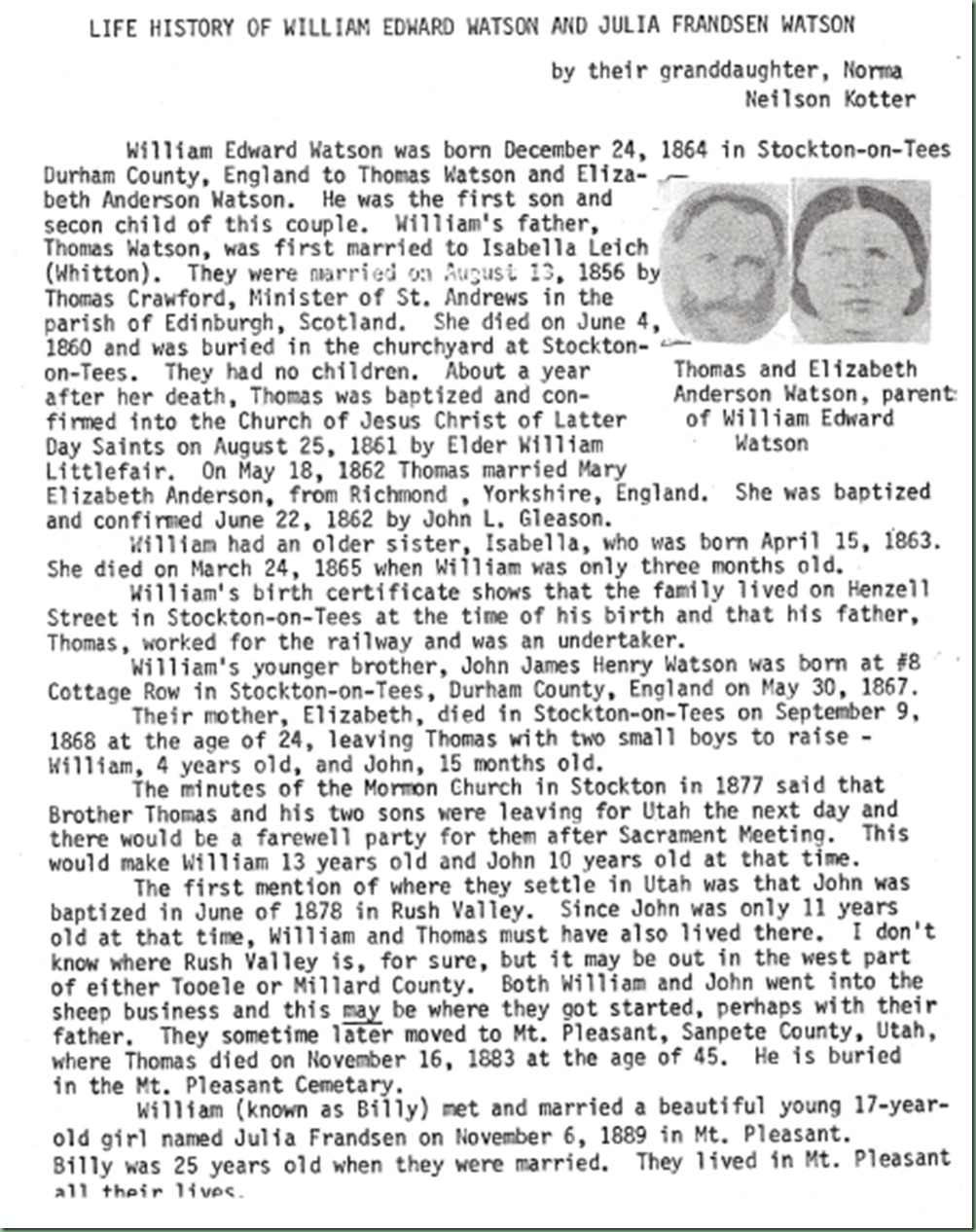
The following is research done by Mary Louise Madsen Seamons

taken from Utah State Historical Society.

(not online, incomplete and an unknown author)

Circa 1858-59

Candland add 1 001_edited
Candland Add 2 001_edited
Candland add 3 001_edited
Candland 1 001
Candland 2 001_edited
candland 3 001_edited
Candland 4 001_edited
Candland 5 002_edited
Candland 6 001_edited
Candland 7 001_edited

The following  are references to David Candland in the Mt. Pleasant History by Hilda Madsen Longsdorf ...


1861

Early in the spring, David Candland, who had recently' ar­rived from Salt Lake City to make his home in Mount Pleasant, located on some land south of the city and east of the cemetery. There was a spring on this land and on account of the scarcity of water, the people objected to his taking it. Later, a compromise was made, and twenty acres of land in the field was purchased and given him in exchange. In June, Bishop Seeley applied to President Young for the privilege of expending a portion of the tithing funds in building a road north through Thistle Valley. p 69


At a public meeting, held July 14th, W. S. Seeley, David Candland and Perry McArthur were appointed as delegates to a county convention to be held at Ephraim, July 22nd. p. 73

Independence Day this year was duly celebrated as the follow­ing account published in the Deseret News will tell:
"At Mount Pleasant the day was ushered in by the firing musketry as the military of that thriving town have not as yet provided themselves with artillery. The stars and stripes were run up, the military were out in force, and some mounted, others on foot. A procession was formed in which a company of young ladies dressed in white, and school children with flags and banners, occupied conspicuous positions. The local authorities, distinguished visitors and others had places assigned in the procession, the citizens being by far the most numerous division. J. K. McCleanahan, Esq., was the orator of the day and David Candland, Esq., reader. An address was delivered by Col. R. N. Allred, which with songs, toasts and various kinds of music, constituted the principal ceremonies. The dance in the evening was not for­gotten." p 81


Social Hall


A building 30 feet x 45 feet, erected in the south side of the church square, was completed on the 7th day of December. A program consisting of singing and of short and interesting talks by Bishop Seeley and Elders Duncan McArthur, David Candland and J. K. McClenahan was held. David Candland delivered the dedicating prayer, naming the building the Social Hall. p 82
This year, school was commenced in the first, third and fourth wards with David Candland, H. P. Miller and Oscar Winters as teachers with an average of forty pupils in each school. p 83

December 7, 1864, David Candland was duly appoint­ed post master, the first to be officially appointed. The post office was established in his home, the southeast corner on the inter­section of First East and Second South. His wife, Annie Woodhouse Candland acted as post-mistress. At a meeting held Decem­ber 24th, William Morrison, the former Ward Clerk, who had succeeded David Candland, was released, having been called south to Sevier Valley, and Anthon H. Lund was appointed his successor. During this year, H. C. Davidsen and family located in Mount Pleasant, later erecting an Astrometer on his lot on west side of State, southwest corner of intersection of First North. He, some years later, gave talks on astrology to the students of Eli Day's school. At a meeting held in the Social Hall, December 25th, it was decided to build a new meeting house.  p 93


Under date of July 5, 1865, the following letter written by David Candland was published in the Deseret News. "We have erected a bowery 100 x 80 feet. Our crops look rather scant, short in straw and thin on the ground. We have now a mail in our town and you can form no idea of how pleased we are, how much we go on Mr. George W. Bean, the contractor. How much we feel to say Amen to every enterprise that aims to give joy and peace and disseminate intelligence among mankind. We are anxious
now for the wire and the rail and for the speed and proper development of our own dear Utah." Copied from Andrew Madsen's Journal: "At this time, David Candland was a very active man in the community." pp 97, 98

1866
Quoting R. N. Bennett: "David Candland was sent with the epistle for the people of Fairview to move to Mount Pleasant, the people of Fountain Green to Moroni, and the people of Spring City to move to Ephraim. John L. Ivie and myself were sent as Candland's body guards. After these families had moved, the minute men of Mount Pleasant and other settlements had to go as guards for the men while they did their work." p110


Under date of March 12, 1868, the following letter written by David Candland, was published in the Deseret News:

"The progressive is a feature of this new fledged city in the agricultural, mechanical, and spiritual. An important area of land is about to be taken up west and south of the city, which will give to our marriageable young men land so as to lay the foundation of a home for them and the help-mates they may choose. The yellow fever of the Sweetwater or of Marysvale is not strikingly manifest here, because the land movement has fore­stalled it. Bona fide homes are better than the miner's camp.

"Mechanically, we are progressing. Your enterprising agent has now a splendid shingle and saw mill. Lath and picket are to be added, and soon, our town will have a decent array of fenc­ing, nor is he satisfied, but has resolved on a woolen mill, to which we say hurrah, for our town! Other solid improvements are going on, and we must not omit to mention a famous brass band of fifteen instruments which is a feature of this young town.

"Spiritually, we are alive. As an evidence, we have raised $4000 for the emigration, and we are not yet broke, although we have been heavily taxed in various ways in common with the rest of Sanpete. Last Sunday, our Bishop sent out some of our young Elders, two and two, to preach in the several wards of this city, and success has marked the project; they are brought to a proper bearing; the people are benefited; and thus spiritual good is accomplished.


"A great scope of country will be put under cultivation for ourselves and the poor for whom we have subscribed, and for as many more, if they will only come. As we believe, more folks, more trades, more independence, and more grain preserved, in our town.

"An eight foot vein of coal of excellent quality has been developed at Fairview, four miles from town, regular Sanpete coal.

This will open the Spanish Fork Canyon road to a certainty. The discoverers are practical colliers, and intend to sell cheap. Utah County can rejoice, for the abundance is great, and the price will be small. Ah, sir! If we only had a railroad down the canyon to Goshen depot, then we would hustle the coal to your city at such figures for the blacksmith and others as would make them all rejoice. As a city, we are interested in our near neighbors' welfare, as we are bound to prosper in their prosperity.


"A Sunday School grows in importance, and so do our five day schools. The demand for a high school is beginning to loom up and also for the appliances needed, maps, charts, globes and thorough teacher. Nor must I forget to mention that the 'News' has taken a new start since you took the chair; (I don't call it the 'easy chair'), and when the opening spring opens the granary doors, and the tons of millions of promised grass-hoppers shall have been undeveloped, and the sun shines that will thaw out the frozen feeling of dread or famine, they, the liberal-hearted will respond to your call for help; broad acres will be sown, and strong belief in the promise of the rainbow will be evidenced. God will give us seed-time and harvest, for we have helped marvelously as a people, to gather the poor, and we sow not for ourselves alone, but for Him and His people and His insect tribes. To Him we look for the promised blessing of the former and latter rains.

"In these days of XXX's, I must not omit to mention the superiority of the Mount Pleasant flouring mill, now thoroughly renovated, with improved machinery, and the finest bolting cloth. The enterprising owners mean your tyros shall test the quality. Nor can we pass our fine blacksmith shops, among whom George Farnsworth as a shoer stands 'A number one.''' pp 120-122


Excerpts from the city record: "Spoke of the necessity of repairing streets, bridges, etc., but it was impossible for the people ~o pay a great deal of money on tax; motion prevailed that a tax of one-half of one per cent be levied for the year 1871." . . . "July 22, motion carried that Joseph Day be city assessor and collector and that he be allowed ten per cent of the city assessments for services in the same." . . . "Motion carried that an appropriation be made for the mayor to purchase the city ordinance of the city of San Francisco of David Candland" . . . "October 15th, Magnus Rosenberg was granted a three months license to sell spiritous and vinous liquors. License granted at $15 a quarter or $40 a year."
pp 135,136

The council took into consideration the plausibility of building a city hall and jail. Moved and seconded to build same, at least as far as to finish the basement, or lower rooms this year. . . . . Salt Lake City ordinances were adopted. . . . . David Candland appointed city attorney. . . .p 147


December 30, 1877, three weeks later.

"A special meeting of the city council was held October 24, 1877, to consider the propriety of building a Lockup, with height enough to admit a general office above, giving room for all city purposes, and thereby save renting and contingent expenses. After some discussion as to finances, etc., Mr. A. H. Bennett presented a bid in three divisions, one for finished Lockup, $275.00, one for Lockup with additional rooms above, $375.00, and one for Lockup with temporary roof for less than $275.00. Council decided that time and necessity for the building and the known honor of the contracting party, no further bids would be asked and the contract was given Mr. -Bennett, agreeable to the con­tingency that may arise as to finances in the matter of completion.

"The signed contract, with two signers was duly signed and placed on file in recorder Candland's office, . . . . . the building was completed and received by the city. Corporation notes for $250.00 were given to Mr. Bennett who delivered two keys to the mayor who delivered them to the marshal who was instructed to get bedding, etc. Councilor Peter Monsen was authorized to purchase a suitable stove." p 154


Saturday, March 1, 2014

Kisten Marie Peterson Olsen and Marie Olsen Beck ~


The following is the second of two original documents sent to us by Dirk Pidcock (address below). The first document was the history of Hans Christian Beck and can be seen on the blog (posted December 1, 2013).

The following history,at one point,  may seem disjointed or that a part is missing, however, I have posted it just as it came in the original folder.