Showing posts with label Syndergaard. Show all posts

Thursday, December 1, 2022

The Ellertson Family


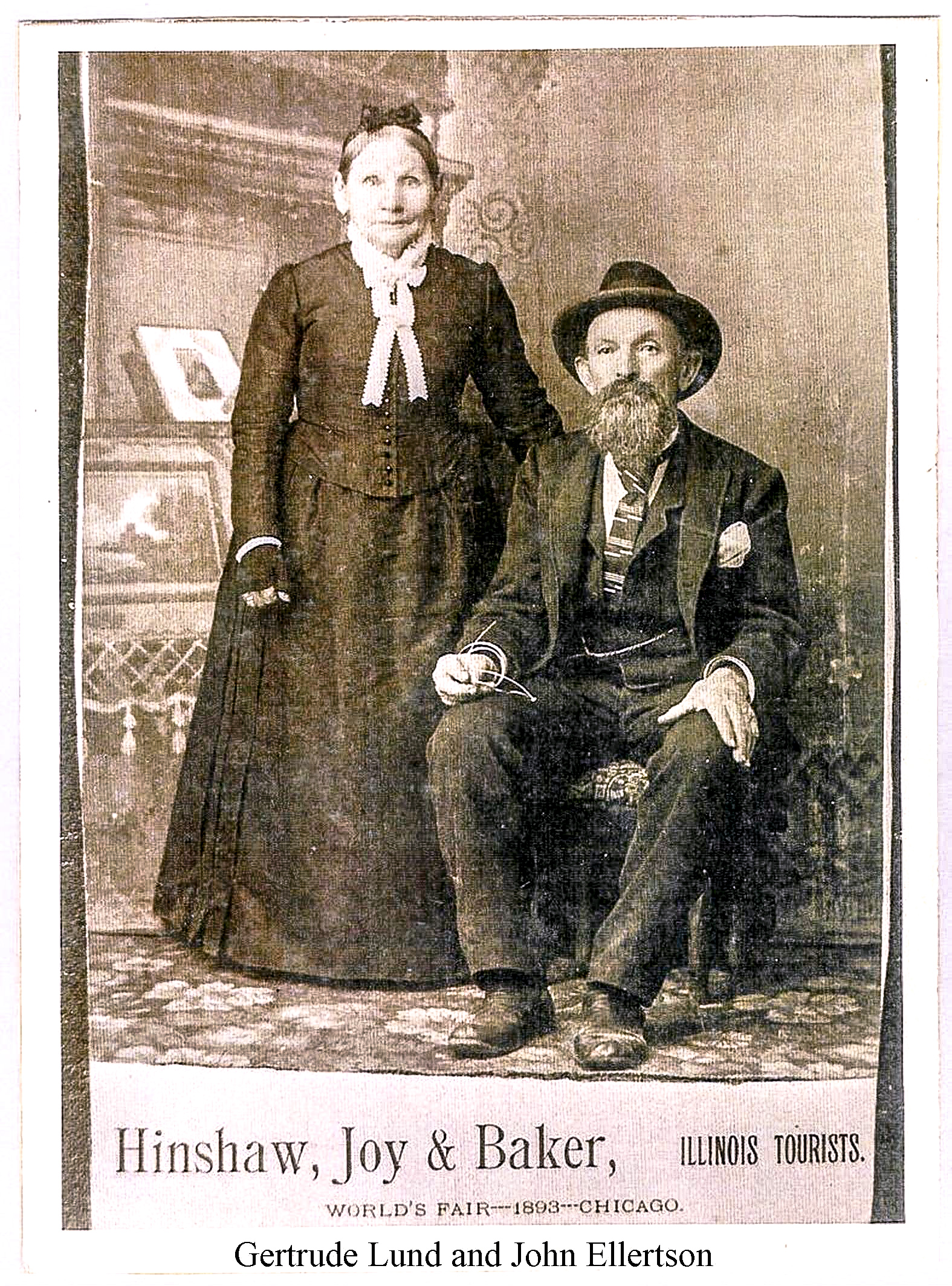
Even though John and Gertrude Ellertson were not listed as Mt. Pleasant Pioneers, many of their family
were.  And many of the family still live here in Mt. Pleasant.
Including Speakman, Reams, Barentsen,Syndergaard 


   HISTORY OF JOHN EILERTSEN & GERTRUDE CHRISTENA LUND


by Ephraim Ellertsen


   John Eilertsen was born on 13 September 1823 in Carlsgave, Frederiksborg, Denmark, the son of Eilert & Barbara (Schadt) Henriksen.  John’s father was a cottager and tailor in Carlsgave.   


   Eilert & Barbara’s family consisted of 10 children, 2 of them dying in infancy.  When John was seven years old his father died leaving his family of eight, with the youngest only four years old.  Because of this death, the family became scattered very young.  John left home between the ages of ten and thirteen years and went to Copenhagen where he learned the trades of blacksmithing and milling. After several years he seldom heard from his family.

  His mother lived to be 92 years old. 

On April 13, 1844 John Eilertsen married Gertrude Christena Lund, daughter of Hans Peter & Gertrude Margareth (Larsen) Lund.  To them were born seven children, the first four being born in Denmark while the other three were born in America.


  In June 1850, Erastus and Willard Snow arrived in Copenhagen as missionaries.  They became very dear friends to the Lunds and Eilertsens.  Two of the Eilertsen children bear their names as also do some in the next generation.


   Gertrude Christena Eilertsen joined the Church with the first converts.  Later that year (1850) John Eilertsen, his mother-in-law Gertrude Margareth Larsen Lund, and her children Hans Peter Lund and Barbara Christena Lund, and her step-children Lars Peter Lund and Angelica Christena Lund.


   John Eilertsen did some missionary work in Copenhagen and then, Friday morning  November 7, 1854, John, his wife Gertrude Christena, three children, mother-in-law, and Lars Peter Lund set sail for America.  Barbara Christenea Lund planned to come to America but at the last minute changed her mind and never did emigrate.  Hans Peter Lund remained to do missionary work.  He came to America in 1857 and returned on the second mission in 1860. The others believed in the Gospel taught by the elders but did not feel that it would be the right thing to give up all they had and emigrate.


  The Ellertsens spent their last night with Sophia Louise who after became the fifth wife of Apostle Orson Hyde.


   They sailed on the steamer “Cimbra”, under the direction of Peter O. Hansen.  They safely arrived at Fredrickhaven on the east coast of Jutland where more emigrants joined them.  Upon leaving there, a fierce wind began to blow.  After several days of practically drifting around, the captain, though an experienced sailor, deemed it necessary to seek the nearest harbor in Norway.  This brought them into a beautiful harbor called Mendel, surrounded by very high cliffs.  In a few days, they again put out to sea.  The captain soon learned that the change was only for a short spell.  He then decided to go back to Mendal, but could not.  They were forced to go back to Fredrickhaven, their first stopping point.  They arrived there on December 9th, 1854.  On the 20th they set sail again.  The weather was worse than ever before.  For two days the ship fought her way against the raging winds and was forced to start back.  The wind suddenly changed, and immediately they steered for Hull landing there on the 24th of December.  The following day they continued their journey by rail to Liverpool, England. 


   They were checked to sail on the ship Helios, but because of the delay, they sailed on the James Nesmith.  Captain Mills was secured for their company.  They set sail from Liverpool on January 7, 1855.  They landed in New Orleans on February 8, 1855.


They sailed up the Mississippi, arriving at St. Louis, Missouri.  In March they continued their journey to Mormon Grove, Weston, Missouri, where Norman Willard was born on the 16th of April 1855.  They remained there for six weeks.  From there they crossed the plains in Noah T. Guyman’s Company.  They arrived in Salt Lake City on September 9, 1855.  They lived in Salt Lake City on 3rd East Street between 7th and 8th South, in part of the home of Lars Peter Lund’s three daughters.  Their mother had died while crossing the plains.  Later John Eilertsen bought two lots between 9th and 10th East and 8th and 9th South Streets.  They then moved o Spanish Fork in 1856 where they bought a home. 


It was there that John Louis and Ephraim were born.  John Eilertsen’s mother-in-law died in Spanish Fork at the age of eighty in 1861.


   John Eilertsen was the first councilor to the Bishop, and his wife was the Relief Society President.  He also married a second wife, Mary Hansen, and one son was born to them, John Paul Eilertsen.


   In January or April 1863 they moved to Spring City, Sanpete County, Utah, where they again bought a home and some farming land.  From there they moved to Mona, Juab County, Utah in June of 1873.  They owned a home on the main street and kept campers and travelers and also worked in the mercantile business.  Gertrude Christena died there on March 26, 1900.  He then married Christena Burrison but lived only one and one-half years after his marriage.


Addendum:

1. From another letter, probably by Ephraim Ellertsen, states:

a. The father of John Ellertson died at age 50.

b. the children of John Ellertson were Henry Peter, Julian Barbara, 

    Hannah Rosetta, Erastus, Norman Willard, John Louis, and Ephraim.

c. Erastus died shortly before they came to America at one year of age.

d. Those remaining said the Lord had blessed them wonderfully and felt

   they should stay and take care of it

2. The fifth wife of Apostle Orson Hyde was Sophia Margaret Lyon.

3. This history as relayed through the Ellertsen Family organization indicated

    that the Eilertsen home in Mona is still standing and that it was purchased by Ray Newton in the winter of 1929 and has been remodeled.  John Louis and his wife Eveline Dinitia lived in this home, after the death of their daughter Floosie  Rosetta lived in the home.  Mrs. Ray Newton was living in the home, in 1977.

4. The spelling of the Eilertsen name was changed to Ellertson.  The descendant of  John, Paul Ellertsen took the name of Ellison.


Transcribed by Elaine Speakman


Neola Gertrude Ellertson Olson One very special spiritual experience for Neola, occurred when she was twelve years old. Because her mother was the Relief Society president, she often attended the meetings to help with the music by playing the organ. She had been taught by her mother and was quite gifted. In one of the meetings, a woman stood and spoke in tongues. She said that Neola would one day cross the waters to preach the Gospel. Another woman then stood and gave the interpretation of this prophecy. This would indeed come to pass because she later served a mission for the Church in the Hawaiian Islands. A cousin who was in attendance at this meeting would later stand and relate the events at another church function. (Neola, my grandmother, told me this story.)


George and Neola Ellertson Olsen


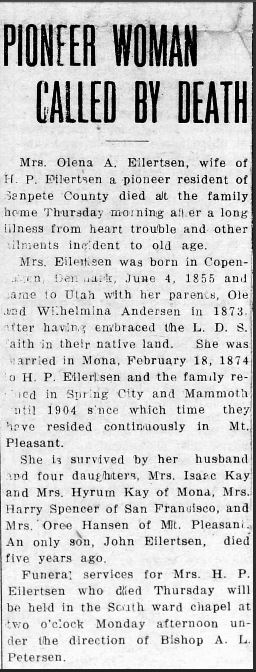
Henry P. Ellertson
A veteran of the Indian War
listed ninth from the bottom 


more information and pictures (including names)
can be found at: https://www.familysearch.org/photos/artifacts/17849010?p=40159700&returnLabel=Neola%20Gertrude%20Ellertson%20(KWCP-GDB)&returnUrl=https%3A%2F%2Fwww.familysearch.org%2Ftree%2Fperson%2Fmemories%2FKWCP-GDB


Friday, June 1, 2012

Mette Christensen and Lars Rasmus Christensen ~ Pioneers of the Month ~ June 2012

The following history is taken from the "Bagnall Family History" and shared here 
with the permission of
Marilyn Bagnall Richards Buchanan 
1976


Monday, March 1, 2010

Niels Christian Johansen (Pioneer of the Month - March 2010)

Niels Christian Johansen
Chris (Blacksmith)
Married:  Gertrude Jensen
Born:  March 17, 1872   ---   Mt. Pleasant, Utah
Died::  November 11, 1947  ---   Mt. Pleasant, Utah

History written by Etta Marie Johansen Larsen (daughter)

In 1872 Mt. Pleasant, Utah, Sanpete County, was a bustling little town boasting a population of 3,000 people.  The people were divided in four groups: those in the southeast part of town were called the "Rocky Heaven" crowd, no doubt named because of the rocks brought down by the creeks in past ages.  In the southwest part of town lived the "Copenhagens" or "Copenslogans" group.  The Danish people congregated in this area.  "Dog Type" was the name tagged on the residents of the northwest part of town.  Northeast residents were answered to the "Buttermilks"; maybe they milked cows or churned butter.

Dad was born March 17, 1872 to Niels and Kirstine (or Christena) Marie Anderson Johansen (Johannes) in the southwest part of Mt. Pleasant in a small adobe house which is still standing and hasn't changed a lot.  H was the eldest of eight children, six boys and two girls.  He also had half brothers and sisters, as Grandfather had been married before.  He was blessed in 1872 and given the name Niels Christian after his father.  His relatives called him "Chris the Blacksmith", but to mother it was "Christian".  He was baptized April 1, 1882, by J.J. Wallis and confirmed April 2, 1882, by Peter Monsen (neighbor) and H. J. Brown.  Dad was made an elder on December 8, 1885 in the Mt. Pleasant South Ward which was shortly before he married mother.  He was made second counselor in the Y.M.M.I.A. of the Mt. Pleasant South Ward, October 2, 1901.

Dad was always an active church worker and served at various times with the Sunday School, the M.I.A., and the Priesthood in Mt. Pleasant North Ward.  He was a Seventy at the time of his death.

I suppose Dad grew up learning to work as there were chores to do, such as hauling wood in for winter, herding cows on the street, helping with the vegetable garden as everyone had a garden those days, helping Grandfather thresh his wheat in the fall, and also helping to haul the hay as Grandfather owned a small piece of ground in the southwest part of town.  He probably helped clean and pick the burrs out of the wool so Grandmther could card the wool for quilts.  Grandfather was a weaver and had his own loom.  I can see Father as a child having many friends, playing with the Copenhagen kids in that part of town.  Some of the games were steal sticks, run-my-sheep-run, stink base, Danish ball, rounders, leap-frog, nip cat, kick the can, mumble peg and marbles in the spring.

He was 24 years old when he courted and fell in love with a shy, timid Danish girl from the north part of town.  He and Gertrude Jensen married January 1, 1896, in the Manti Temple.  They went to Manti with two other couples in a bob sleigh, staying overnight with friends, and came home the next day.  They lived two blocks east of his parents in a small adobe house.  They lived there only a short time and then moved over on Main Street to Grandmother Jensen's home to take care of her until she died October 21, 1899.

Blacksmith shop was located at approximately 350 West Main
To them were born eight children:  Christella, Pearl,  Heber Christian, Francis Simon, Mable Christine, Aldevea Gertrude, Lester Delbert and Etta Marie.  After his marriage he herded sheep for a short time.  Later he went into the blacksmith business with George N. Clemensen.  After working with him for a few years and learning the trade, he went into the blacksmith business for himself.  He build his shop on Main Street on the southwest corner of Grandmother's lot.  Blacksmithing was a good, steady job.  Dad worked hard, being very skilled in blacksmithing, he was a perfectionist in his work.  Early of a morning he would usually sharpen hay knives so as not to waken the neighbors.  H often shod the horses in the afternoon after the sun had gone behind the shop, or he would work under the apricot trees.  When by accident Dand and horseshoing would get on the lawn and near Mother's flower beds, she would get very upset.  Toward fall he would be working mostly on plow lays and wagon wheels as the farmers would be getting ready to haul coal from Fairview Canyon.  The rims, which were always metal, would have to be smaller than the rim base, so it was up th the blacksmith to heat and stretch the metal rim, so it would fit snugly over the wooden edge.  The plow lays would have to be sharpened and often iron would have to be fastened onto the toe of the plow lay.  The farmers would do their fall plowing just as they do today.  Dad saved all the scrap iron he could find and it came in handy, especially during the war years when iron was scarce.  The fire in the forge had to be red hot when he was working so anyone standing around would get a turn pumping the bellows by hand.  One could almost tell what type of iron or steel was being pounded out by the ring of the anvil, as each had its own tone or beat.  It was music to ones ear, as a neighbor said.  I think Dad made the most money on shoeing horses.  Of course, I'm sure it was the hardest and most difficult to do.  Some of the men a few years ago told me he got fifty cents a shoe and he furnished the shoes and nails.  Many happy hours were spent with Dad in the shop, pumping the bellows, dodging the sparks as he pounded out a horseshoe or plow lay on the anvil, using up his chalk to draw pictures on the walls, a handfull of nails  to hammer in the big log that served as the doorstep for the shop.  The kids coming to and from school would stick their heads in the front door.  Dad would give them a few nails to hammer in the log.  Some of the ladies from the South Ward would tell how their kids took the long way home so they could visit with the blacksmith.  The grandkids also liked to be at the shop; sometimes they would run away from home.  Dad would soon send them back home; he didn't want the little ones around unless their mothers were wit to watch them.Blacksmithing was slow in the winter time and that was good as Dad needed a rest, for he worked so very hard.  The folks always had a good supply of food on hand; flour, grain mash, and in the cellar with long rows of smoked hams, shoulders, and sides of pork hung from the log ceilings.  In the big cupboards were shelves lined with bottles of fresh peaches, pears, apricots, plums, big crock jars of jam, pickles, relishes and of course a couple of five gallon cans of honey.  Then there was the milk cupboard with a tight screen on the front for the milk, cream.  Potatoes, carrots and parsnips were kept out in the dirt cellar which was in the corral.  Dad and Mother had two gardens, one a small one which we kids were responsible for planting, watering, and weeding.  Then we could take vegetables from it whenever we wanted as long as we didn't waste any.  We would have play dinners of fried potatoes, carrots, cooking on almost any stove in the neighborhood.  Dad always had a milk cow, chickens and pigs.  He owned five acres of ground west of town.  He would raise grain on one half and hay on the other half.  Every few years he would change the hay and grain ground.  There was a row of fruit trees down the center.  He would exchange work with the farmers to use their horses and implements to do his harvesting, so you can see there wasn't much in the food line that Mother and Dad had to buy at the store.  A little sugar, coffee, a can of salmon or maybe a piece of cheese, but Mother would always have to ask Dad for the money.  I sure had my share of going to the shop and asking Dad for money for groceries.  I didn't mind because he would usually find a couple of pennies in the bottom of the old leather purse fo me to spend for candy.  H was surely free-hearted when he was spending the money himself.  He liked to surprise  us by bringing home treats.  One day he had gone to town to get horse shoe; soon he came back in a truck with a big phonograph and several records, os for days after that he would bring a record home.  At Christmas time Mother would say that he was a big show off because he gave us so many presents.  Each summer he would see that Mother and I would have a train trip to Axtel to visit Mother's brother, Andrew.  Dad would cry when we left and he'd cry when we came home.  He was a very emotional person.  He would shop for all of  Mother's clothes and sometimes he would bring home several pairs of shoes for Mother to try and she would keep the pair that she liked best.  He would take the others back to the store.  He would buy the best grade of calico for her dresses and aprons.

Mother would go with Dad to Sacrament Meeting and the old folks parties.  She liked the picture shows and he took her often.  After I got a little older, he would say, "Take your Mother to the picture show, I'm too tired to go tonight."  Often if he three of us were home alone, Dad would say, "Sis, run up and get us an ice cream cone."  There was Gunderson's Candy Store a block and a half east of our home and it sure got a lot of Dad's money.

Dad was the boss and all we kids knew it.  If there was any arguing or quarreling going on up at the house, Dad was soon up there straightening us all up. Dad handled the money and if we ever wanted money for a show ticket or whatever, we had to ask Dad and he wasn't one to hand it over very freely.  I'm sure this was the way Mother wanted it.

Dad loved to entertain and play with his children and grandchildren, telling ghost stories, romping on the floor with them.  He would get on his knees under the big dining room table and walk it all around the room.  Mother would hold her ears when the kids would start to scream and yell.  The year 1918 when the whole family had the flu and we were all quarantined, he put up a big swing in the shop and built a whirly-gig out in the garden spot.  When almost everyone had the flu, Dad would go with Dr. Syndergaard to the homes of the sick in Mt. Pleasant and the neighboring towns.  Sometimes the horse and buggy would get stuck in the mud and Dad and the doctor would have to get out and lift the buggy up out of the mud.  Sometimes they would be gone all night.  A few weeks ago, an old neighbor, Ray Seely, told me about Dad coming down to their home in the middle of the night to borrow their old gray mare so he could go to Schofield to ber with Heber who had the flu.  The doctor had called and said Heber had taken a turn for the worse.  Dad rode all night long, but with Dad's faith and doctoring, Heber got well and was able to come home.  Dad was a good nurse and when we were sick, he usually was the one that nursed us.  I remember that he had a bottle of consecrated oil in the bedroom window.  He honored his Priesthood and used it whenever he felt it necessary. 

Dad was with the volunteer fire department most of his married life.  There were  many major fires, like the one in 1898 that destroyed most of the buildings on the north side of Main Street.  Also in 1930, Pat Cammer's barn burned with tow little ones, four and two years old in it.  Dad was the one that found them.  This really upset him for a long time.

Mt. Pleasant weathered three major flood in 1893, 1918,1946.  All went roaring down through the main section of town, distributing mud, rocks and debris on each side of Pleasant Creek, through homes, stores and streets.  The one in 1918 Louis Oldham lost his life.

The year Dad was born, 1872 the first post office was built in a small log building.  The same year the Indians and the white men signed a Peace Treaty ending the Black Hawk War.  The D & R,G Railroad started its run from Salt Lake to Mt.  Pleasant in 1890, as well as the telephone system from Fairview to Mt. Pleasant.  The first telephone and telegraph operator in Mt. Pleasant was Annie Johansen, (Little Annie) who was Dad's half sister.

In 1929 came the depression and the banks had to close their doors.  Some families went hungry, but not the N.C. Johansen family because of the storage that Dand and  Mother had on hand.  They had to help the married kids out with their little families.  Dad did have to drop all we kids life insurance and he borrowed money on his life insurance policy to pay his taxes on the land and home.  There just wasn't any money to be gotten.  He lost around $200.00 in the bank.  He did work for the farmers and they would pay him in produce which was anything from hay or grain to raspberries or honey.

Wednesday, October 22, 1941, was Dad's first trip to Salt Lake City.  He went with Gottfred and me into Granite Furniture Store to buy our furniture.  A few years later, he visited in there with LaRue and Bud.  Bud took him to all the interesting places.  He never stopped talking about what a good vacation he had.

Dad loved celebrations, like the 4th of July when he would put his anvil out in the middle of the road and at the break of dawn, he would blast off dynamite, waking up the whole town.  He was often duptized to help the town marshal at celebrations.  He was often called to serve on the jury, which he said he didn't like.  He was water master for many years, served on the stove committee for the old folks part, was president of the committee in getting the old folks pension into effect before we had social security.

Dad was large in stature, over six feet, weighing from 225 to 250 pounds, a giant of a man.  As long as I can remember, he wore a mustache and he loved to make the ends curl.  He wore a cul on the top of his head, as his hair was quite wavy.  His family broke his heart many times, but he still stood by them supporting them in all things.  He loved them very much.

In later years, Dad didn't have mujch to live on.  I asked him once why he didn't collect some of the money that the farmers owed him.  H had two record books in the shop.  When he did work for someone, he would write their name and what he had done  in one of the books.  Then when they paid him, he would cross their name off.  There were many names that weren't crossed off.  He said, "I guess they have paid me and I've forgotten to cross their names off, if not, it doesn't really matter, they are all honest men."  I remember him burning the one. but I believe he kept the other one.  Maybe he did believe that some of them owed him.

I don't remember of Dad being sick much of the time, only the spring he would get really sick with the hives.  They found out later that it was the fruit which seeds that was causing them. By not eating those fruits he was okay.  In his later years he had arthritis really bad and all I remember he did for it was a copper bracelet on each wrist.

Dad was a frank, plain-spoken person, kind, homest and full of fun.  He was respected and loved by his family and friends.  He retired in 1944 and passed away November 11, 1947.

Tuesday, February 2, 2010

Marie Johansen Syndergaard, Pioneer of the Month - February 2010


Marie Johansen Syndergaard (wife of Andrew Jensen Syndergaard, Daughter of Niels and Christana Johansen)

Marie Johansen was born on June 2, 1850 in Aalborg, Denmark and died April 6, 1924 in Mt. Pleasant, Sanpete County, Utah.

Her father and family joined the L.D.S. Church in 1860.  The family left Denmark for America in April 1862.  They came across in a sailing ship, on which there were no conveniences and sanitary conditions were bad.  They were nine weeks crossing the ocean.  She often spoke of the seasickness of all the folks on board.  She and another girl about her own age were the  only ones who were not ill during most of the voyage.  She liked the ocean, the trip was a great adventure for her, aside from being presed into service in caring for the sick.

The family came across the plains in the Harriman Company and arrived in Utah on October 5, 1862.  She walked all the way.  The company was met in Immigration Canyon by some of the earlier settlers.  Mother orode into town, the campaing grounds which were located where the Salt Lake City and County Building now stands.  This was her  first ride during the long journey.  Here they visited with her aunt (Grandmother's sister) and family, who journeyed on to California the next day and were never  heard from again.

The family was sent to Lehi to settle, where they stayed for three years.  At that time, there was still much excitement about the Johnston Army that had camped on the shores of Utah Lake-Cedar Fort.

The family moved from Lehi to Mount Pleasant in 1865.  Here they were really pioneers.  It was a barren country, inhabited by Indians who were hostile to the whites.  They lived in a fort to protect themselves from the Indians.  All work done outside the Fort was done in groups, such as going to meadows for hay, farming, hunting, gathering wood and provisions.
As soon as the settlers were able, they built homes and moved away from the fort.

Grandmother Johansen died leaving 6 children.  Mother had to assume the responsibility of taking care of the children.  She spoke of the terror she suffered nights when all the men were called out to fight the Indians.  One night, Indians came to the window, it was a full moon and she saw them and heard them talking.  The beds were on the floor back in the  shadow where they could not be seen.  She said she held her hand over the mouth of the smallest child for fear  it  might make a sound.  The Indians left without molesting them but that period of time had seemed like an eternity to her.

Grandfather Johansen had been a professional weaver in Denmark, so it was  possible for him to weave carpets, rugs, cotton materials such as tablecloths, etc.  From the sheep, they clipped the wool, washed, carded and spun it into yarn which was made into woolen cloth for suits, men's suits, dresses, children's clothes, wool blankets, etc.  The yarn was also made into stockings and mittens.
In the season of harvesting sugar cane, Grandfather and the boys operateda molasses mill.

He also did carpenter work and made tables, chairs, dressers, beds, etc.  Bed springs being an unknown item at that time, thebeds were  made with round  knob pegsall around the side and end rails, back and forth, cross ways and lengthwise, rope  or rawhide was laced to make a foundation for straw mattresses and feather beds.  The furniture was nice enough to be used even in this day.

Grain was harvested by  scythe or cradle scythe.  The women were inlisted to help  bundle the grain.  There was much waste so women and children gleaned the fields after the harvest.  Mother did much of this helping to provide winter flour for the family.

They also gleaned bits of wool from the brush where the sheep had ranged during the summer and early fall.  This would provide an extra of warm knitted stockings or mittens, or wool bats for quilts.  They died the yarn sometimes into fancy tied and dyed designs.

Besides gardening and raising, poultry, the women made their own soap, lye from wood ashes for softening water for laundry, starch, candles.  Also, the women did family sewing and tailoring.  They did the curing of meats from home slaughtering and from meat from the hunt, rendering of lard and storing food for winter, such as dried fruits and vegetables such as corn and peas, etc.

In the community, there was a tanner  who prepared the skins of the deer.  Mother made buckskin gloves from these skins.  This enabled eht men to do much heavy work during the cold winter months, road building, cutting timber.  Many expressed deep appreciation for this.

She also did fine needlework, eyelet embroidery, tatting,  netting or filet lace, crocheting, knitting (stockings for the family), carding wool, spinning and weaving the yarn into homespun from which warm suits and clothing was made, tailoring even men's suits, and homemade blankets.  she was a leader in every phase of industry and my earliest recollection is of folks coming to her for help.

Marie Johansen married Andrew Jensen  Syndergaard on October 18, 1869.  They were married in the Endowment House in  Salt Lake City, Utah.  She took with her, her two youngest sisters to care for.  To this marriage, 13 children were  born.  She cared for many  more children, sometimes taking in whole families when the mother had died.  Thus, it became necessary for her to spend many nights spinning and weaving, sewing and mending after having done a hard days work.

After the Indians became friendly, they used to camp in our yard when they came into town in the winter to beg.  In cold weather, they made their beds on the kitchen floor and roasted their meat over the fire in the kitchen stove.  They depended on her for most of their provisions.  This was not always a pleasant ordeal but it was better to have their friendship.  Old Santaquin, Nephi Indian Jim and Joe used to bounce the children on their knees and hum weird songs while father and mother finished their evening chores.  It used to take days to get rid of the sage brush smell after these visits.

Because mother was a good cook and always had good things to eat, our home was the meetingplace on Sundays.  The grownups ate and went to church and the children in the neighborhood were all taken care of.  Mother sometimes in a half joking and half pensive way wondered what could be done about saving her, while she washed the pots and pans and cared for the children while the Good Folks Worshipped.

She never attended school in America but she spoke good English, perfect enunciation and read and wrote.  She always said that America was her adopted country and she would learn its language because  it  was her language.  She was a keen mathematician, always figuring a problem mentally before others could write it out and she did this with speed and accuracy.

She had a hard life but with all a remarkable logic and philosophy.  She was a hard and  conscientious worker.  Her motto was "What was worth doing at all, was worth doing well"  and she always managed to do it just a little better than anyone else.  She would never spend time sewing cheap materials.  She had a contempt for shoddy things.

She did her part in caring for immigrants that came.  This was not always a pleasant task because the old sailing vessels that brought the emigrants were infested with all kinds of vermin which made it impossible to make the trip without being contaminated.  This was a hardship to the families who took them in.  The first job being to get them cleaned up.

No one ever left her home hungry.  She fed everyone, a kindness that was too often taken advantage of by many.

Author:  Elizabeth Jensen Syndergaard, originally typed October 22, 1964; 7th child of Jacob John Heidemann Jensen and Elizabeth Hansen; wife of Neil Anthony Syndergaard, 9th child of 13 children of Andrew Jensen Syndergaard and Marie Johansen.

Retyped by:  Carolyn Syndergaard Caddis, Granddaughter of Annie Elizabeth Jensen and Neil Anthony Syndergaard, June 24, 2005.

Monday, February 1, 2010

Andrew Jensen Syndergaard, Pioneer of the Month ---February 2010


Andrew Jensen Syndergaard was born on May 11, 1851 in Sundby, Denmark and died on  May 19, 1912 in Mt. Pleasant, Utah.  Andrew was the son of Jens Christian Syndergaard and Ane Kirstine Larsen, (Annie Catrine Laursen).  His father died when he was seven, and his mother, with two sons (Peter and Andrew) and two daughters, (Ingaborg and Elsie Marie) came to Utah, crossing the plains in an ox-train under Captain Madsen.  They arrived in Mt. Pleasant in October 1962.  Later another sister, Ane Marie, came to Mt. Pleasant.  Here his mother bought a farm, which the boys worked.


At the age of 14, Andrew stood guard at the temple site in Manti.  The Indians were very hostile at that time.  A large Indian that jumped out from a pile of logs was shot to death almost within arms reach of him, an experience that tormented him for years.

During those early years, no one paerson went out of the city limits alone.  They went in companies when they cut hay in the meadows and if a member of the party got very far from the rest, the whole company, the whole company stopped until he could catch up.

In his early life, he did freighting to Pioche, Nevada.  He was one of the men commisssioned by President Brigham Young to haul the oxen for the St. George Temple from Salt Lake to St. George, which was a difficult task over the roads which were then not better than a cow trail.

In 1868, he went east in Bishop William S. Seely's Company.  He was about 17 years old then.  This was to bring immigrants to Utah.

He married Marie Johansen, daughter of Niels and Christiana Johansen on October 18, 1869 at the Endowment House, Salt Lake City, Utah.  At this time he was 18 years old and built a house for his new bride at 389 West Main Street, in Mt. Pleasant.

Andrew was a Black HawkWar Veteren.
He was always active in civic affairs.  He was one of the first town marshals.  He served on the City Council.
Insert from the Mt. Pleasant Book - page 167
"The December 4, 1889 city record shows that Councilman Syndergaard moved that coal oil lamps be placed as follows.  One at Hans Nielsen's corner, one at N.S. Nielsen's corner, one at Peel's corner, one at the Co-op corner, and one at Church Square.  The five coal oil coal oil lamps, which were said to add a dignified appearance to the city."

Andrew also worked on the Sanpete Valley Railroad,  He delivered ties from Pleasant Creek Canyon to near Freedom.  He was also active on all frontier projects, building roads, exploring forest, cutting timber, etc.  He and his brother, Peter, joined John Hasler's Brass Band which was  organized in 1870.

One of his outstanding accomplishments was befriending the Indians.  They always camped in the yard, fed their horses from the hay stacks and ate their meals at the table, made their beds on the floors when the weather was cold.  The Indians often counseled with him about many things.  These were the indians that lived in Thistle Valley.  Their Bishop finally forbid them, imposing in that manner, so they camped at the Tithing Yard but they, the Indians, came to the house to visit and often sneaked their outfits into the yard, inspite of their Bishop's request not to do so.  One old Indian spoke of him as "Heap Big Man - Heap Good Man".  Andrew always said the easiest way to get along with the Indians was to keep their friendship.

Andrew and Marie had 13 children.  Andrew, Gertrude, Kate, Annie M., Hyrum, Anthony, James, Olive, Parley, and  Hortense.  Lars, Anna and Joseph died at early ages.

compiled by Della Fern Barentsen Standlee (Great-great granddaughter of Andrew)
Inserts taken from the"Mt. Pleasant Book" 1859-1939; "History of Sanpete County",
parts of the history written by Annie Elizabeth Jensen, (wife of Neil Anthony Syndergaard, 9th son of Andrew)

Andrew's wife, Marie Johansen Syndergaard Biography will be posted tomorrow.