Showing posts with label Frandsen. Show all posts

Tuesday, June 30, 2026

NIELS PETER MADSEN and wives CAROLINE FRANDSEN and MARIE WILHELMINAKRAUSE


Niels Peter Madsen


 HISTORY OF NIELS PETER MADSEN AND LARS MADSEN

 Written by Anna Mina Louise Madsen Remund (Daughter of Niels Peter Madsen) December 1958 Typed from the original by Linda Cox Retyped by Richard Cox, Sept. 2011 Niels Peter Madsen was born September 17, 1832, the son of Lars Madsen and Bodel Nielsen. He was born in Svinnige, Osherred, Denmark. He had two sisters and five brothers. They belonged to the Lutheran Church and used to walk two miles to their meetings.

 Two Mormon missionaries, Hans Lund and Lars Ericksen from Mt. Pleasant, Utah, converted all the family to Mormonism. In 1854 the entire family was baptized and became members of the Mormon Church. In 1854 they decided to sell their estate which had been in the family for generations and go to Utah (Zion) in the United States. Then the family separated; three sons and two daughters went to America. The parents and youngest son, 8 years old, should go the next year, and the oldest son should remain to take care of their business and come to America the following year. Their father, Lars Madsen, went with the sons and daughters to Copenhagen, Denmark, arriving there in November. He [Lars] bid them goodbye, not knowing it would be the last time he would see them. Fate of Lars Madsen He [Lars] died one year later in November 1856, at Devils Gate, Wyoming, while coming to Utah. The Hodgetts and Willie Handcart Company were near Devils Gate, traveling through a terrible blizzard and deep snow. They were half starved and frozen. My grandfather Lars Madsen and my mother, Wilhelmina Krause, age 8 years, were walking together. He turned to go back. Mother [age 8] followed him, but he pushed her with his cane to go back. She cried and thought he was mean to her. They soon missed him, and found him dead in the deep snow. They made a shallow grave and buried him, then made a fire on his grave so the coyotes couldn’t smell the corpse. 

Back to the Lars and Bodel Madsen Children; On November 29, 1855, Canute Petersen (later of Ephraim) was chosen president over the Mormon emigrants on their ship which sailed from Keil, Germany. [this included three sons and two daughters of Lars Madsen, one of which was Niels Peter Madsen] They landed there at midnight, and from there they took a train to Gluckstart, Germany, arriving there the next day. Then they sailed for England. They were four days on the North Sea and then went by train to Liverpool. 

On December 6, 1855, they [three sons and two daughters of Lars Madsen] boarded a ship called John J. Boyd. There were 508 persons aboard. Apostle Franklin Richards who was there on a mission came on the ship and bade them farewell. They set sail and were soon out of sight of land. Many became seasick. The ship was overloaded. They had to sit on boxes, and also to eat. It wasn’t a very pleasant voyage. On December 19th [1855], a terrible storm came up. The ship 2 rocked and knocked over boxes and everything. Christmas Day the storm continued. One of the masts split and was wrapped with chains, and the sails were taken down. The captain was very discouraged over conditions. He forbade them to sing or pray, but that didn’t prevent the Saints from fasting and praying as their leader told them to do. The lord answered their prayers, and they go better weather. Then they came upon a ship drifting in the ocean with broken masts and sails. They lowered their life boats and rescued forty men and their valuable belongings. These sailors were of great assistance to them. A day later a fire broke out under the Captain’s cabinet and smoke poured out on the emigrants in the lower deck, almost suffocating them before the fire was put out. The Saints knew God would answer their prayers, and they would arrive safely in Utah from any such terrible deaths on the ocean. Their food was very coarse, and it had to be rationed. There were six grown people and fifty children died and were buried in watery grave. After a long tiresome voyage of eleven weeks and three days, they arrived in New York. They stayed at Castle Gate two days, then took a train for St. Louis, crossing the Mississippi on ferry boats. They arrived in St. Louis March 1st, 1856. They couldn’t speak English, and it was hard for them to get along. On June 1st, 1856, President Petersen gathered a company and they sailed on a steamboat to Winter Quarters, where they began to make preparations to go to Utah. 

President Petersen was made Captain. He appointed a captain for each ten wagons. On June 26th, 1856, they started on their journey across the plains for Salt Lake City [Lars, Bodel, and Wilhelmina Krause would start their ill fated crossing with the Hodgetts Company later in the summer]. It was a hard trip. Some of the oxen were wild and they didn’t know how to handle them. The next day was hot. The oxen were very tired, traveling with their tongues out. They had heavy loads and were compelled to unload some of their supplies and leave them by the roadside. One day they had a stampede. Their oxen became frightened, rushed together, and some wagons were broken and one man killed. A few more were injured. Indians were roaming from one side of the valley to the other. Sometimes they would visit the Saints and they gave them food and supplies, but they had to watch them and guard their oxen so they were not stolen. Every morning they were called together by the sound of bugle to receive instructions. Sundays they had meetings and rested. During the week on some days they would walk along, laughing and singing the songs of Zion. After three months of a tiresome trip, they arrived in Salt Lake City on September 20, 1856. They stayed there a few days, then sold their oxen and bought provisions. They traded a cook stove for a yoke of young steers. While in Salt Lake City, they met President Brigham Young and the leaders of the Church who impressed them very much. Plight of Lars Madsen, Bodel (Nielsen) Madsen, and Wilhelmina Krause Then the Madsen sons and daughters went to Kaysville, Weber County and lived. Their parents and young son, eight years old, and my mother, Wilhelmina Krause, 8 years , came with the William B. Hodgetts Company. They had to assist the company of Captain James D. Willies and Edwards Handcart Company. These people endured many hardships. It was late in the season,the Indians had run off with their cattle, and handcarts were breaking down, it was getting late in the fall, beginning to snow, even blizzards. It was a pathetic sight as weary old men and women, and little children drew their handcarts alongside the pioneers’ wagons for protection from the cold. Their shoes were wearing out, and the men had to wrap burlap around their feet. It would freeze on them and they had to sleep with the frozen burlap on their feet at night. 

Brigham Young heard of the Hodgetts and the Handcart Company. It was conference time. Apostle Franklin D. Richards and some missionaries were traveling with horses and teams, returning to Salt Lake City when they passed these companies. The ground was then covered with snow, and the next morning it was so deep it almost prevented the companies from traveling. It was so cold that many oxen died and the others were weak and poor. They had to discard some of their bedding and leave it by the side of the road. Conditions were terrible. They had only one week’s supply of food. Their clothing was in rags, and some had bruised and bleeding feet. Old men were tugging and pulling their carts which sometimes carried a sick wife of child, or a wife would be pulling a cart carrying a sick husband. Even though it was Conference time, President Young and others arranged for some men and wagons to go back and rescue them, or they would all have perished. 


At Devils Gate, Wyoming, the Hodgetts Company was snowed in, and Mrs. Madsen’s husband, and our grandfather, Lars Madsen, died of exposure and was buried there. This relief company came and helped them, and when they arrived in Salt Lake, Peter came with an ox team from Weber. The Madsen children had not heard from their parents since they left Denmark, and they didn’t know their father was dead. Peter took them to Kaysville to their home which consisted of a dugout and wagon box room of food. It was a sad meeting of mother and children, all feeling the loss of their father and husband. The mother was very tired and weary from the effects of exposure and the trials of the long journey they had endured. She had left a good home and had suffered much during the trip. In addition, she had to leave all of her possessions on the plains. Nevertheless, she was glad to again be with her children, and even though she had sacrificed so much and endured so many hardships on this journey, her faith in God and the religion she believed in was unshaken. She felt it was the will of the Lord. She told this [the following] story to her children. They sailed across the ocean in the ship Torton. They landed in New York, then took the train for Iowa City, remaining there for six weeks. Late in August they joined the William B. Hodgetts Company for the long and tiresome journey to Salt Lake. 

As soon as the Madsen boys got material, they built a house in Kaysville where they where they remained until President Brigham Young called a number of families to go to settle Sanpete. The Madsen’s of Mt. Pleasant First they went to Ft. Ephraim, but the Madsen boys were not satisfied there. They wanted to go to the northern part of the valley. President Young said if they went where Mt. Pleasant now is they should build a fort as the Indians were very unfriendly and had burned down Hamleton, a city west of Mt. Pleasant. All the Madsen boys came to Mt. Pleasant and helped build the fort. The people lived in the fort until they thought it was safe enough to move out and build cabins, but when the drums beat, they would all run back to the fort for safety. 

 The pioneers were a sturdy ambitious class of people. They were all given twenty-acre lots and farming land. People came from the east and west, from land and sea. They came in many companies and handcarts, horses, and ox teams. There were different nationalities – some Scots, Norwegians, Germans, Danes, English, Canadians, etc. They endured many hardships but all were good workers and soon cleared the land, making ditches to irrigate their lots and land. They planted grain, potatoes, etc., and built large nice homes where they planted lawns and trees, made fences, and eventually got electricity. This is how the beautiful city of Mt. Pleasant was built. 

 These Madsen brothers were among the rest of the pioneers, doing their part in building the city which they all felt was so near [dear] to them. The Indians were very unfriendly. They killed a number of families who were in the fields working. Brother Kuhre’s parents, brothers and sisters were all killed. They thought he was killed, but he lay by his mother’s body. My sister-in-law’s grandmother and children were all killed. The father had to stand and see them killed. The Black Hawk Indian War lasted three years. It was heart rending to read about the many white men who were killed leaving large families. Horses and cattle were stolen from the pioneers. When the men went after their horses the Indians would lay in ambush and kill the men. Minute men were ready to be called and fight them when the Indians came.

Caroline Frandsen Madsen 


 It was in this terrible Indian War the five Madsen men fought. Father [Peter Niels Madsen] was in many of the Indian battles. In 1864 he with 60 men were called to go to Salina Canyon where they fought the Indians. Later he was called with the Sanpete Military. Another time he and others were sent to get the cattle from the Indians after they had been stolen. Father had the best horses, and the Indians were always trying to steal them. These Madsens were very prominent men. They all held big responsibilities and all did their part in building Mt. Pleasant. They all had large families, and their children went on missions and held high offices in Church and city offices. 

Father and Mother [Peter Niels Madsen & Anna Mina Louise Krause] were married January 2, 1864 in the Endowment House in Salt Lake City [Anna Mina Krause was the 9 year old girl who traveled across the plains with Lars and Bodel Madsen]. He was bishop for many years. Mother was president of the Relief Society, and President Young and the leaders of the Church stayed at her home when they were in Mt. Pleasant. They had a family of ten children. Joseph, the oldest son, died when he was fourteen years old, and Freddie died at three months. Father held many prominent positions including city councilman and school trustee. He had an interest in the branch of ZCMI store and was part owner in the first saw mill and threshing machine that came to Mt. Pleasant. The Madsen boys all married and had large families. Their descendants are among the most prominent people in the West. 

On July 6, 1909, a monument was erected in Mt. Pleasant in honor of the pioneers, and father’s name was on the right plate. He enjoyed good health until just before he died, on September 30th , 1909 at the age of 77 years. He had one of the largest funerals ever held in Mt. Pleasant, and was buried in the cemetery at Mt. Pleasant, Utah.


~~~~~~~~~~~~~~~~~~~~~~~~~~~~~~~~~~~~~~~~~~~~~~~~~~~~~~~~~~~~~~~~~~~~~~~~~~~~~


MARIE WILHELMINA CATHERINE KRAUSE
Born: 27 April 1847 Svenborg, Fuenert (Fynn), Denmark Age: 9 Hodgett Wagon Company Wilhelmina was reportedly a very “comely” and beautiful girl. Her parents were both from Germany. Her mother, Anna Lucia Simonsen Abel, had been widowed previously. When Anna’s first husband died, she inherited a wheelwright nail factory. Anna advertised in the Danish Star News for a manager to take care of the business and Johan H. F. A. Krause answered that advertisement, was hired, and proved to be very capable. He and Anna married and became the parents of six children. 

Wilhelmina went to her father’s nail factory one day and picked up a red-hot nail that had dropped on the floor, thinking it very beautiful. It left a terrible scar the rest of her life. Another incident at the nail factory would also influence the course of Wilhelmina’s life. A crowd had gathered outside the factory where two “Mormon” missionaries were passing out literature and announcing a meeting they would hold in the woods that night. Wilhelmina’s mother and her friend, Marie Frandsen, attended and participated in the singing. A mob of persecutors soon came with ropes and clubs, but the missionaries were able to escape and find shelter in the woods. Anna and Marie learned where the Elders were hiding, took food to them, and invited them to Anna’s home to hold another meeting. 

At this meeting, the same mob came, broke the door to the Krause home, and told the missionaries to leave the country. Before leaving, the missionaries gave each of those present some literature and hymnals.Wilhelmina received one of those song books and cherished it throughout her life. She loved to sing and had a beautiful singing voice. Other missionaries soon came and taught the gospel to the Krause family. Johan was not interested, but Anna requested baptism. She did not tell her husband. She secretly attended meetings for about two years and finally revealed her actions to her husband, requesting that he take her to “Zion” to gather with the Saints. Johan did not wish to leave his successful business, but he was also a kind man who didn’t like to see his wife unhappy. She would often sing from her little book this hymn: “Oh, Zion, when I think of thee, I long for pinions like the dove, And mourn to think that I should be so distant from the land I love. A captive exile, far from home, for Zion’s sacred walls I sigh, With ransomed kindred there to come and see Messiah eye to eye. While here I walk on hostile ground, the few that I can call my friends, are, like myself, in fetters bound, and weariness our steps attends. But yet we hope to see the day, When Zion’s children shall return, When all our grief shall flee away, and we again no more shall mourn. The thought that such a day will come, makes e’en the exiles portion sweet. Though now we wander far from home, in Zion soon we all shall meet. Johann finally decided to sell the business and go to America. It was decided to let one child remain in Denmark with friends and go to America the following year with those friends. The children drew lots to see who would stay and the lot fell to Wilhelmina. The rest of the family left from Liverpool in 1855 with a company of four hundred Saints aboard the ship Charles Buck. The Krause family traveled as far as Mormon Grove, Kansas, where Anna and two daughters died of cholera in July 1855.

 From Wilhelmina’s biography we read: Thus, Anna’s hope and cherished dream of gathering to Zion with the Saints was not to become a reality, but her great faith paved the way for her daughter, Wilhelmina, to be among those whose names were to be carved in Utah’s history. Meanwhile, in Denmark, Wilhelmina was unaware of the tragedy in her family and was preparing to sail with the Frandsens when Marie Frandsen’s brother tried to prevent Marie from going to Utah by telling the officials that Marie was stealing a child to take with her. The police officers took Wilhelmina’s clothes and precious song book and placed her in an orphanage with little but a gray uniform. The missionaries were finally able to make the truth known and obtain her Niels Peter and Wilhelmina Krause Madsen 349 Hodgett Company 

This biographical sketch comes from the 8th edition of the book Tell My Story, Too: A collection of biographical sketches of Mormon pioneers and rescuers of the Willie handcart, Martin handcart, Hodgett wagon, and Hunt wagon companies of 1856, by Jolene S. Allphin. This pdf edition (2017) has been edited, with some stories updated, and some corrections made. See also www.tellmystorytoo.com. Individual sketches may be used for family, pioneer trek, Church, and other non-commercial purposes.

.  The Elders arranged for Wilhelmina to travel with the Lars and Bodel Madsen family in the next emigrant group. Wilhelmina became very close to Brother and Sister Madsen. One morning while waiting out the bad weather and unloading the wagons at Devil’s Gate, Wilhelmina went with Brother Madsen a distance from the camp. When he collapsed in the snow, Wilhelmina cried and wanted to stay with him, but he took his cane and pushed her away, telling her she couldn’t stay or she would freeze. By the time she returned with help, Lars had died. 

 Wilhelmina stayed with the widow Madsen and eventually married her son, Niels Peter. They settled in Mt. Pleasant, Utah, where they had a home in town and also homesteaded a 160-acre piece of property. Bodel Mad Niels Peter served on the City Council and also as a Bishop for 13 years. Wilhelmina developed an infection in one eye, causing her to go blind in that eye, but she continued to read to her children from the Book of Mormon every night. Her children said that many times they saw her crying as though her heart would break. She would then go to her bedroom to pray and come out smiling, feeling God had given her the strength to bear her troubles. 

Eventually, Wilhelmina placed an ad in a St. Louis, Missouri, newspaper to advertise for her family. Her father was notified and soon he and his daughter, Augusta, arrived in Salt Lake City. They stood on the steps of the Deseret News Building each day for a week, inquiring of passers-by for information. They were about to give up when they met a man from Sanpete County and asked him if he knew a George Frandsen. The man knew the Frandsens and Wilhelmina and after 32 years this family was reunited. Wilhelmina’s father stayed in Utah for a month. Although Johan Krause does not seem to have made any efforts to locate his daughter prior to this, he maintained that the Mormons had stolen her. He returned to Missouri where he and his step-son, Frederick Abel, had become wealthy in St. Louis, pioneering in the plumbing business. They were both reputed to be millionaires and bought one of the first Pierce-Arrow automobiles in that area. 

Frederick visited Wilhelmina at one time and offered her anything to renounce her faith and return with her children to St. Louis where he would see that they had every advantage, but she refused. She did keep up communication with her sisters, Augusta and Caroline. Caroline sent her a gold band ring and told her if she didn’t see her in this life she would know her by her ring in the next world. After Wilhelmina’s very full and happy life, she was buried with the ring on her finger. “Sister Mina” served as a Relief Society President and was beloved by all. She played her accordion and sang to her neighbors. 

Her children wrote a tribute to her: “By her teachings and her good example she instilled into our hearts the good things of life, and taught us to live the Gospel which was so dear to her. She has been a beacon light to us all our lives and made an impression on us that will always be with us. She had a testimony of the Gospel. She knew it was true and that there is a God who answers prayers. She paid a full tithing and kept the Word of Wisdom and we never heard her swear or even use slang.” Sources:“The Life Story of Wilhelmina Krause Madsen” by Pearle M. Olsen and Aleen M. Summers; “Mt Pleasant,” by Hilda Madsen Longsdorf; email from David R. Gunderson, June 30, 2012.

 See also Lars Madsen story in Tell My Story, Too; familysearch.org. (See painting representing Wilhelmina entitled, “Trust in God,” by Julie Rogers, at tellmystorytoo.com.)

Tuesday, October 1, 2024

IDA CAROLINE POULSEN LARSEN and Lauritz Larsen ~~~ Pioneers of the Month ~~~ October 2024


Lauritz Larsen Jr.


Excerpts  from the Mt. Pleasant Book  with Lauritz Larsen

 Page 99 …… July 15th, General W. S. Snow was put in command of the Sanpete Militia. Three companies were at once organized at Mount Pleasant, with the following officers: Fredrick Nielsen, Captain of Company A, he, however, resigned and Lauritz Lar­sen succeeded him; Company B, with Jacob Christensen, Captain, and Andrew Madsen, First Lieutenant. The Home guard, called the Silver Greys, consisted of older men with John Tidwell as 'Captain. While the organization of the Militia was being effected throughout the country, word had been received that Anthony Robinson, of Monroe, and Robert Gillispie, of Mount Pleasant, had been killed by the Indians near Salina. Fred J. Keisel, who later became mayor of Ogden, was Indian Agent in Sanpete County and he wisely withheld ammunitions from the Indians.
The settlers procured bars of lead, which were melted in special heavy vessels, and poured into bullet moulds, making bullets to fit certain guns used. These, with gun powder carried in a powder horn, was the usual ammunition. That ammunition was very valuable is shown in the following quotation from Gott­fredson's Indian Depredations in Utah in a statement made by Jos­siah Sylvester. "I was out of ammunition and was informed that Elijah B. Ward had been seen molding bullets for his pistol, which was the size I wanted. Someone went with me to get them. It was dark and we had no light.  As Ward's corpse was laid out on a trunk or chest, we had. to raise him up, while I searched for the bullets until I found them."

Page 129
Mt.. Pleasant Z. C. M.I.
In February 1869, the Mt. Pleasant Z. C. M. I. was organized. It was a co-operative organization patterned after the Z. C. M. I. that was organized the year previous in Salt Lake City, under the instructions of President Brigham Young, who at that time pointed out to the people the necessity and the benefits of such institutions. The Mt. Pleasant Z. C. M. I. began business in a small room, in a log building, afterwards known as Anderson's Blacksmith Shop, on the east side of State Street, about Third South. Here Anthon H. Lund served as clerk. After a time, the Company erected a log building on the southwest corner, intercession of State and Main Street. Quoting Amasa Aldrich: “This was quite a creditable building at that time, being built  of logs chinked with mud. The room on the inside was plastered with mud. Outside, above the door, which faced the east, was painainted the sign 'Z. C. M. I.' Underneath this was painted the
“All Seeing Eye,' and beneath that, 'Holiness to the Lord.' This was the first store building built in Mt. Pleasant, and became known as the Mormon or Polygamist Store. Charlie Hampshire, and Olaf Sorensen were clerks who served. Charlie spoke English and Ole spoke Danish, hence the people could always be served, because when one could not understand the customer, the other could. There were many customers and on Saturday one would have to put in the better part of the day trying to get waited on. Blenda Dehlin and Lauritz Larsen Sr. later assisted as clerks. The store carried a various line of merchandise and people could get most anything needed. The mischievous boys of those days would remove chinks from between the logs, reach their arms in and help themselves to the stick and rock candy." Produce was

Page 131
President Young and a number of the twelve apostles again visited the community. They were met by the brass band, the Sunday School children and a great many saints. At a large gathering held in the bowery, Joseph F. Smith, Wilford Woodruff, George A. Smith and George Q. Cannon spoke of the benefits of  co-operation and home manufacturing, and also dwelt on the Word of Wisdom. President Young pronounced a blessing upon the people, begging them to live their religion. Many good instructions were received and the saints rejoiced much over the visit. Lauritz Larsen was at this time serving as the church re­corder. The grasshoppers having nearly disappeared, the people "were successful in again raising a large crop of grain. The Union Pacific Railroad had reached Ogden and many implements were shipped into the territory. A combined reaper-mowing machine, called "The World," and a hay rake were purchased and brought to the town by C. W. Anderson and Andrew Madsen. This was the first rake and machine brought to Mt. Pleasant.

172

council concerning the placing of the poles, and for the use of the Public Square for peeling them. Council thought the example of larger cities worth considering, and it was decided that the poles should be placed in the center of the street.
    At about this time Larsen Brothers, Lauritz, George, and Peter A., built a dance pavilion on State and Third South.
In 1892 the city experienced a serious epidemic of diphtheria. resulting in many deaths and causing much sorrow among the people.


182

Miss Annie Johansen, formerly the telegraph operator, was the first telephone operator. This, however, was not the first telephone in Mt. Pleasant. Sometime, about 1874, there was no telegraph operator in Fairview, and a make shift telephone line, using the telegraph wire, had been installed be­tween Mt. Pleasant and Fairview, that the telegrams received in Mt. Pleasant for Fairview, might be sent on. Miss Annie Johansen. the telegraph operator in Mt. Pleasant, having charge of Mt. Pleas­ant and Peter Sundwall Sr.; and Hyrum De Frieze operating at Fairview. This, after a fair trial, on account of wire trouble, was abandoned.
In 1901, the Mt. Pleasant Commercial Bank erected their building on the north side of Main Street between Second and Third West.
The mountains east of the city had in the past produced a great deal of lumber, and about this time and later, a number of mills were operated, among these later lumber dealers from time to time were: E. L. Durphy, Lauritz and Peter A. Larsen, John H. Seeley and James Monsen. Large forest fires were often seen in the mountains.
The Union Mercantile Company was organized in 1903, by Andrew Madsen and sons, Andrew C., Anthon and Neil M., and C. W. Anderson, George Christensen and Olaf E. Olson. For a number of years, they occupied the brick building known as the Co-op Store building, and the building now acquired the title of the Union Building. .
     January 22, 1903, Thomas Braby was officially appointed Postmaster of Mt. Pleasant.
October 10th, Lars P. Madsen, Bishop of the North Ward, while coming down Cotton Wood Canyon with a load of coal was thrown from the wagon and killed.
In March 1903, while George Christensen was mayor, the city voted a bond for water works, but not until 1905, during H. C. Beaumann's term, were contracts let for installing the system. In due time, the system was installed, and with its completion. the settling barrels with their prickly pears, which had been used at most every home for the settling of the roily water, disappeared.


198

January 21, 1915, L. P. Nelson was appointed Postmaster, and after a short time the office was moved to the Armory (Hansen) Hall building.
Mt. Pleasant in 1913 again became noted in the baseball field, and professional players were imported. City records show that in 1914, a two day baseball tournament was held.
It is interesting to know that the game was introduced in Mt. Pleasant by Ras Freston, in 1875. At that time, the team was: Ras Freston, pitcher and c. f.; John Gustave Johnson, pitch­er; John Stansfield, catcher; Bennett Munk, s. s.; Pet Burrison,
1st base;………,  2nd base; and Herb Day, 3rd base. Tom
Coates and Bill Averett, field; John L. Larsen and Eph Day, subs.
They, at that time played on the north public square. During the middle eighties, they were known as "Cracker Jack" teams. Among the players then were: M. G. Rolph, George Christensen, Bert Wheelock, Ed Freston, Ras Freston, Erick Gunderson, Lauritz Larsen, George Day, Charl Averett, John H. Hansen, Hans Jensen. Joe Clark, George Sears, Hyrum Farnsworth, and others. For several years, the personnel of the teams were made up of these people. The Red Stockings and the Resolutes became famous for their playing. Games were played on the public square, and on the ground later purchased by the city for a city park.


237

1904-5. Mayor, H. C. Beaumann; Recorder, A. H. Maiben; Treas­urer, E. Ellis Day; Marshal, Andrew S. Jensen; Justice of the Peace, A. B. Waldermar; Councilors, A. E. Mcintosh, (16) Joseph Monsen, A. C. Madsen, George H. Marshall, (17) A. C. Wall, S. E. Jensen, Bent R. Hansen.
1906-7. Mayor, James Monsen; Recorder, A. H. Maiben; Treas­urer, Sarah E. McClenahan; Marshal, Richard Hendricksen; Justice of the Peace, A. B. Waldermar; Councilors, Christian Johansen, A. Merz, A. O. Madsen, George Brand, Joseph Monsen.
1908-9. Mayor, James Monsen; RecorderLauritz Larsen; Treas­urer, Mrs. Rhea Wambolt; Marshal, Hans Poulsen; Justice of the Peace, A. B. Waldermar; Councilors, Thos. West, N. P. Madsen, E. W. Wall, Christian Madsen, Christian Johansen.
1910-11. Mayor, Ferdinand Ericksen; Recorder, Daniel Rasmus­sen; Treasurer, Authinal Carter, (18) William Hansen; Justice of the Peace, Justus B. Seely, (19) John Carter; Councilors, Lauritz Larsen, Christian Madsen, Jas. W. Anderson, Jas. D. Simpson, Thos. West.
1912-13. Mayor, James W. Anderson; Recorder, Daniel Rasmus­sen; Treasurer, Mrs. Elizabeth Larsen; Councilors, H. Leroy Neilson, A. E. Mcintosh, Justus B. Seely, (20) George C. Sorensen, A. Merz, Lauritz Larsen.
1914-15. Mayor, Abram Johnson; Recorder, Daniel Rasmussen; Treasurer, Elizabeth D. Larsen; Councilors, Nils Larson, four years; E. C. Johnson, J. C. Jordan, H. Leroy Neilson, Joseph Monsen. (Abram Johnson resigned during his term and Jos­eph Monsen was made mayor and Andrew Larsen became a councilman. )

P 278
The pioneer homes were noted for their hospitality. There were then, as now, certain groups who especially enjoyed associating together. Because of the variety of nationalities represented, even in so small a community, they were better able to understand and enjoy the association of those who came from their mother countries.
One group consisted of the following men and their wives: Peter Monsen, Hans Poulsen, Niels Johansen 1st, Mortin Ras­mussen, Hans Brown, and Christian Jensen 1st. This aristocratic gentleman could entertain them with stories of how he had worked for the King of Denmark.
This group met at their different homes and enjoyed dancing to the music of the fiddlers John Waldermar, Jim Hansen and Lars Nielson.
Another group which met often and enjoyed their suppers and dancing were: Mr. and Mrs. Frans Christensen, Jens Hen­dricksen. Lauritz Larsen, Jacob Christensen, and Taylor Johnson, who was a very pleasant and jolly man, making great fun for everyone.


327

In 1866, Paul Dehlin had sort of a sawmill machinery oper­ated by a big water wheel, placed in the stream on Main Street between Third and Fourth west about where the Clyde property is now located.
In 1864 William Jennings established the Jenning's store, on the lot where William Hansen now lives, north side of Main Street between Second and Third west. It was managed by Joseph Stanford. Anthon H. Lund and Charlie Hampshire clerked there for a short time.
About 1869 a Co-op store was started, later this company erected a building on the southwest corner of the intersection of Main and State streets.
A few years later on account of the increasing business of this company they built a brick building on the northeast corner of intersection Main and State streets.
The brick for this building was made west of town under the direction of Andrew Madsen and C. W. Anderson; Martin Rasmussen, James C. Meiling and others did the burning. Among those who did the excavating were John Meyrick, Paul Coates, Sr.; Lars and Andrew Christensen were masons, and Jacob Rolfson and Eric Gunderson, Sr., were carpenters. Nothing but first class bricks or materials were put into the building at that time.
The same clerks, Charlie Hampshire, Ole Sorenson, Blenda Dehlin, and Lauritz Larsen, served in this building; among those who later served were Wellington Seely, Wm. Morrison, Jr., Stena Jensen, Louise B. Madsen, Caroline Johansen, Nora Jorg­ensen, Lena Madsen, and Minie Johansen.
In 1898 the Equitable Building was erected and the stock transferred there. This company built the Branch Building on Third South and Second West, which for some time they operated in connection. Later Tathen and Dun. Then George Christensen, then the Progress Branch, and then Paul Monsen and Vern Gunderson were located there.
In 1893 the Union Mercantile Company was organized. They did business in the brick building formerly occupied by the Co-op store. In 1897 the company was reorganized as Madsen & Sons Mere. Co., who were in business for a number of years. Madsen & Longsdorf began business in the building in 1898


Lauritz Larsen, Jr. (the tall guy in the rear)


/> 

Wednesday, June 1, 2022

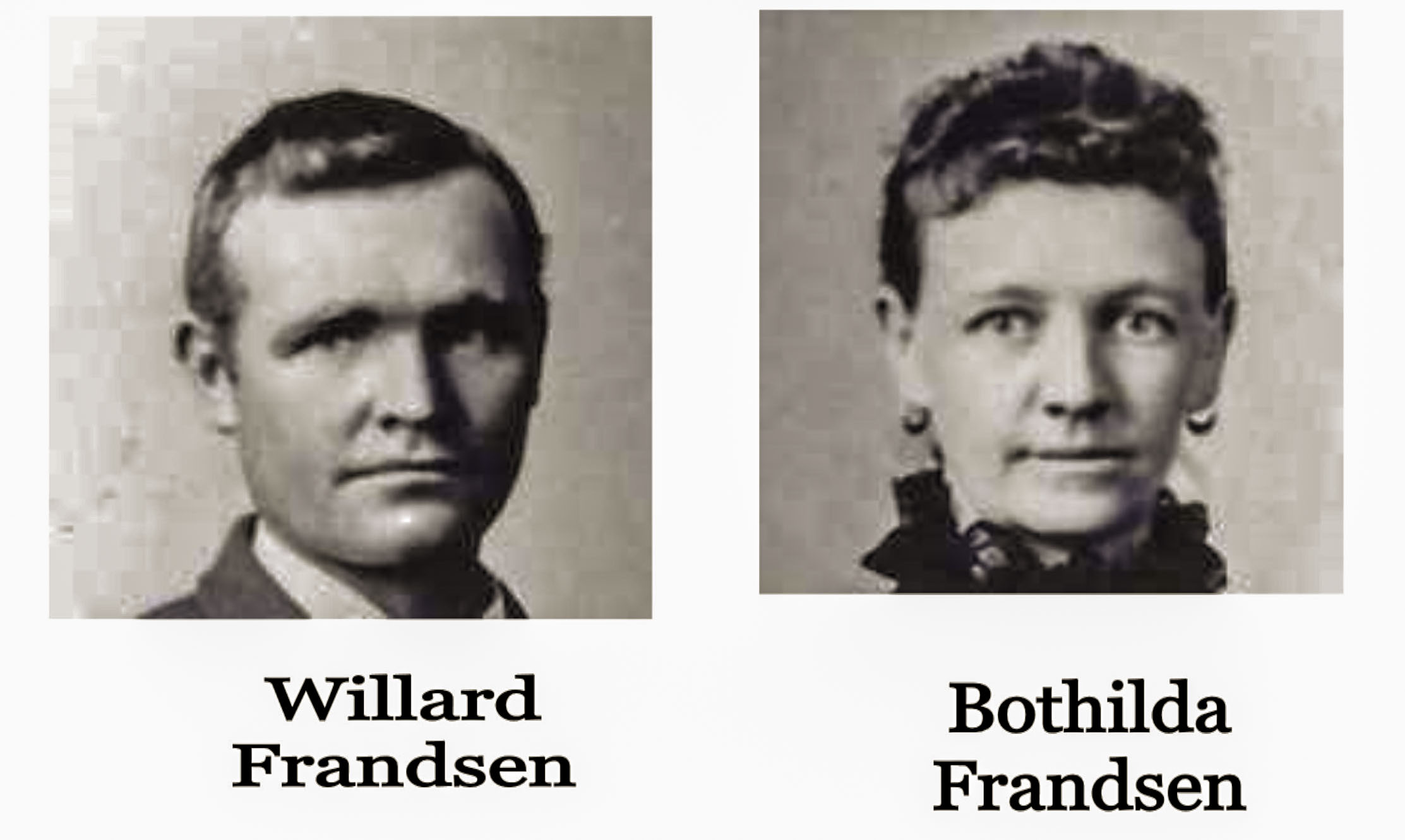
Willard and Bothilda Frandsen ~~~ Pioneers of the Month ~~~ June 2022


Willard was born on 14 August 1963 (7) in Mount Pleasant, Utah. He was the third and youngest son of Margretha and Rasmus Frandsen. He was born into a polygamous home, as there were 10 children in 12 years to the two sister wives. 
During these 12 years, the third wife gave birth to four children. She had six children later. 
It was a busy household. Willard spent many years on the floor of the large living room and kitchen with his homemade toys. While his mother churned, sewed, baked, and ___, he loved the beehive of activity. He always dreaded the days his mother was away caring for the sick or just visiting. 
His dresses were kept clean (boys wore dresses until they were six years old) and his soft white curly hair, which he wore in ringlets, was washed every Saturday night when the family bath hour arrived. 
He loved to eat. He always enjoyed the crisp carrots they grew in the garden and especially the Codling and Sweet Bough apples that grew in the orchard. He was always hungry. He lived across the street from the school. Many times he would take a sandwich to eat at recess and then go home for dinner. 
He loved the farm animals, especially horses. When the men rode away to fight the Indians, it was his greatest desire to get big so he could ride away on a fast horse. His father had chosen horses for this purpose. 
At the early age of six years, he herded the cows in the field. He loved the cows, but his stick horse became rather boring. Catching frogs was his favorite pastime. At times, he would get so interested his cows would stray and he would be worried until he found them. He loved to catch birds. The birds would make their nests in old tree stumps. He would thrust his hand in quickly before the bird had a chance to fly out. One day a large black snake wound itself around his arm. Its ugly head was near his face. After that, he was more cautious about catching birds. 
At times he would go with his father at haying time. He would help rake the hay his father had cut with the ____. All the men would set the day for haying. They would go to the open fields and cut fast for all they cut was ends. It was hard work with but little rest while the race was on. The boys enjoyed seeing their fathers cut more than their neighbors. Also enjoyed the huge lunches and jugs of homemade beer brewed especially for the occasion. Too much water made the thirsty men ill. When the new invention of unloading hay with a fork came his father would not accept it. He said that it was a sign of laziness and anyway he could pitch the hay off the load faster. 
He loved the Indian stories his father would tell after a scrimmage. When they became friendly came to the homes and begged. One day his father was giving an Indian some flour and he stuck his hand in the flour and the Indian slapped him. He never forgot the result. While he was herding he often came in contact with the Indians as they crossed the fields going to town. He learned many of their customs and spoke a good deal of their language. One day he was hanging around their camp watching them prepare a meal of cricket soup. He was playing with the Indian boys when the father invited him to eat. He was afraid to say no as they were easily provoked and he didn’t want trouble. The soup went down but he didn’t want a second helping. Because of his acquaintance with the Indians, Brigham Young sent him to Indianola to get the Indians to come to Mount Pleasant to sign the peace treaty with Black Hawk. This treaty was signed in the Bishop Seeley home, now the Mount Pleasant Relic Hall.  (folklore)
He went to school in several different buildings in Mount Pleasant. He finished the eighth grade. One time he climbed on his father's chicken coop and found a piece of mirror in the sun and into the teacher’s eyes. He was immediately caught and given a sound whipping with a hickory stick which the teacher kept on hand for such tricks. He went to Provo where he attended the Brigham Young Academy. He was a good student and always loved to read. He often quoted from his teacher, Karl G. Maeser. 
He was an active boy. He loved to play with the neighborhood children. Run Sheep Run and Kick the Can be favorite games along with Ball and Tap Cat. He loved to dance. He often paid his ticket with a post or bushel of potatoes he had earned by hard work.  
It was at a dance he met Bothilda Hansen. It was no easy matter to court her as she lived three miles west of town. But loved the horseback ride, which was his only means of transportation. She would always carry her dress. She would always wear something warmer for riding and she must keep her lovely dress fresh and clean for dancing. Many nights after Choir practice he would pick her up on his horse and they would ride the long distance on one horse. She would always ride side-saddle. He loved his horses and always kept them clean and well-groomed. He felt a man was judged by the way he kept his horses. Sleigh riding was a favorite pastime. The bobsleigh was made ready with straw and quilts and hot rocks. Then it filled with young people. After a few hours of riding, the gang would go to Bothilda’s place or some other home for donuts and buttermilk or homemade beer if the girl could talk her mother into it. 
At the age of 23, he married Bathilda. The date was 24 June 1886. This was a very happy relationship. She was a good housekeeper, cook, and mother. She loved to sing. She was the daughter of James Hansen. He played the violin at the dances and led the choir. They continued their love for dancing and horseback riding all through their lives. They were on the dance floor at the Church Parties, old folks parties, and masquerade balls. And would often waltz in their own home by music from the radio when they were in their early 60s. 
They spent the first year of their married life in his mother’s home as the house was large and the family is mostly gone. During this yar, Willard built the one-room frame house on the Homestead farm north of town. They moved into it soon after their first child, Farrie was born. 
The farm was in its primitive state. It was covered with sagebrush even higher than their heads. Much hard work was required to get the land in shape to be cultivated. The bush was grubbed and stacked in piles by hand. In the evening the piles were set on fire and burned, much to the delight of the children. Potatoes and onions were roasted. The hard work was turned into fun and frolic. Mother’s flowers made the desert farm blossom as a rose. New rooms were added to the house as the family grew larger. Eight children, to boys and six girls, were born and raised in this house, just outside the city limits. 
Willard was very good and kind to his family always wanting them to have the things he had missed in life. Willard spent his summers on the farm and his winters on the desert herding sheep. He had invested his hard-earned savings in sheep and was anxious to see them thrive and produce well. This was difficult work. Horses and wagons were used to haul food and supplies. This was difficult work. Tents were used for sleeping. Most of the cooking was done in the open. Dutch ovens and open kettles were their utensils. Many nights the young wife spent in tears when a letter was received saying that he had gone to bed with his eyes full of ashes and belly full of burned bread. Then in the hard times of Pres. Cleveland and the panic of 1893, prices were low and the winter was hard. The expenses were too great. The result was the complete loss of his sheep. This was a hard blow, as he now had a family of several children to support. His wife, Bothilda, took on sewing at this time to help over the crises. She dried corn to sell and also churned butter to sell.
Cattle were his means of making a living but he also loved horses and would have a fine animal to sell. These horses always brought top prices. 
He owned a hay bailer, the first in Mount Pleasant. He would bale his hay then pull the bailer near the stack. The men would pitch the hay to a table. From this he himself would feed it into the bailer in small forkfuls. A man would arrange the wire and tie it. When a certain length was reached a block of wood was placed in the bailer to separate the bales. A team was hitched to the plunger and were driven around and around to furnish the power. This was hard work for the men but they seemed to enjoy it. The said while they worked. One of us children followed the team to keep them at a regular speed. This was extremely monotonous as we followed around and around. He would move his bailer wherever hay was to be bailed. Often going to the Schofield valley where enough hay was bailed to keep him busy all fall. One time he went to Abraham Millard County. While bailing here the youngest son was born. He named him Abraham after the beautiful Abraham valley. This baby was a beautiful little fellow, so fat and healthy, but at the age of 9 months he became ill and died. This was a great sorrow to them both. Bothilda never quite got over it. She was so happy when he came to their home. She felt she couldn’t spare him. 
One day we children came home from school and a large box was on the porch. We knew at a glance a piano had been in the strange box. Sure enough, when we went inside to see it, there stood a beautiful piano, the grandest sight we had ever seen so large and shiny. This piano was one of the first three in town. We were indeed proud. This replaced the organ we had used to practice on. Brother John Hastler who had sold us the piano gave lessons as a bonus. On Saturday mornings at 6 a.m. every three weeks, he would come to our home to give 5 of us children lessons. He would always have breakfast with us and then on to his next students for dinner he would go. The piano was bought on the installment plan as few things were. $500.00 was a very large sum to raise. One time he hardly knew where to get the $50 due and we were all worried about our precious piano. Then one day, he came in the house all smiling. He had found a way. The Ringling Brothers Circus was coming to town and wanted his ground for a few days. We were excited waiting and wondering what the circus was like. Finally the day arrived. We were all up at daylight and down to the depot to see the train unload. What a thrill—so many cars loaded with strange animals and beautiful floars. We hardly knew where to go to see the most. We reached home ot see the huge tents raised by the elephants. The cook tent was a buzz as the cooks prepared food for all the workmen. Finally, the 10:00 parade started.
Never had we seen such beautiful cages with wild animals, steam callia, clowns, and beautiful horses with lady riders. How we were thrilled when the leader would call, “Follow the parade to the showground”, and we knew that they were going to our farm. All that day we watched the circus three rings of acts, sideshows, and menagerie. We watched far into the night as they lowered the tents and led the elephants back to the train. The small town had become a large city as people came from distant towns and pitched their tents or parked their covered wagons in the streets. Her they cooked on open fires, many brought their milk cow for their fresh milk. Boxes of chickens were brought to supply meat. Baskets were baked in dutch ovens. Every street was a campground. This circus was a never-to-be-forgotten experience. They returned to our farm for three years. 
One day a large iron box affair was being loaded into our home. When the men had completed the job it was the first Home Comfort Range in town. Peddlers always stayed at our farm where they could get feed and care for their horses and so the range for their company. Fruit peddlers always stayed with us. Jews came as peddlers to sell their wares. One Mr. Pink made his early visit a new folding cane part for care of the team. His yard was often filled with horses and wagons as many as 20 or 30 campfires in the evening and mornings brought the smell of bacon and coffee being prepare. He always worried about the fires and would often make a trip to the yard late at night to make sure the fires were out. 
Occasionally a fruit peddler would become discouraged and ready to pull out, Will would feel sorry for him especially the young men and buy the balance of his load. Our cellar would be full of peaches, melons, or sweet potatoes, often mother would dry the peaches to keep them as her jars were already full. 
His fear of fire urged him to buy hanging lamps to replace the high foot lamps on the table when the children got big enough to climb. It was a fear of starting a fire from the coal oil. The only water supply was a creek one and half blocks away. Later a well was dug and a central pump put in. But as there is little in Mount Pleasant most of the water was pumped by hand. This was a big chore for him on wash day. Filling the reservoir on the range and a large copper kettle outside. 
Willard had large gallows where he would butcher for individuals and the butcher shop. Often Indians came begging. While they were tame and quiet, white people never lost their fear of them. They would camp by the Tithing Yard when the Bishop would supply them with hay and grain for their horses. The school children all loved to see them, with their bright-colored shawls and gay clothes. It was always a thrill to see a tiny papoose. Their tiny papooses were always smiling and good-natured. As a squaw came to the door begging you always felt like giving more if she had a cute little baby jogging along on her back. Two or three squaws would come together. When they would receive anything, they would immediately sit on the ground and (END OF DOC)


Bothilda Johanna Hansen Frandsen

 My grandmother, Talula Johanna Nelson, told me this story about her Mother, Bothilda Johanna Hansen. Bothilda and Hannah Seeley were born the same year (1866) in Mt. Pleasant and were extremely good friends. It was a sad day for both of them when Orange Seeley and Hanna Olsson Seeley answered a call to go to Emery County to settle that country in 1879. They were all packed up and it was very early in the morning, but Orange knew how much these two friends loved one another. He stopped his team and Botilda ran out to hug her friend and say goodbye. Talula thinks that was the last time they saw each other, but I read that Hannah rode to Mt. Pleasant to see a dentist. She may or may not have visited with her friend Bothilda.

 My daughter Victoria Ferris has been friends with Jenny Oaks and I have second cousins who descend from Orange Seeley and am reading the book President Oaks wrote, "Lessons Learned." My reading in this book made me think of the little story I have written here. If any of you want to see Bothilda Johanna Hansen on Family Search.