In the spring of 1852, under the direction of Madison D. Hambleton and Gardner Potter, about half a dozen families proceeded to move northward from Manti, for the purpose of establishing a new colony. Among these settlers were Henry Wilcox, John Lowry Jr., William Davis, Seth Dodge, and John 'Bench. They located on both sides of the stream, just below where Mount Pleasant is now situated, and north of the main road running east and west. The stream, now Pleasant Creek, they named Hambleton, and the settlement was given the same name in honor of the leader of the company. Early in March, at the mouth of Pleasant Creek Canyon, just below where the Mount Pleasant City Power plant is now located, they erected a saw mill known as the Hambleton and Potter Mill. They commenced cutting timber and sawing lumber for the purpose of building their homes. They cleared the land and began farming about a mile slightly northwest of where the D. & R. G. depot is now located; planting crops on the south side of the creek, near the place where they built their homes. They enclosed some of the land with substantial fences, and raised a fair crop of wheat that year, and at the same time, the Hambleton and Potter Mill was turning out lumber and shingles.
Saturday, June 1, 2013


Wednesday, May 1, 2013
Moroni Seely ~ Pioneer of the Month ~ May 2013
The following history is taken from the Seely Family History, and written by Deloy F. Seely
 |
| Moroni Seely and Emily Alice Seely |
In 1851 my parents moved to Pleasant Grove, Utah. There I received my first schooling but it did not amount to much as I was not able to attend regularly. I was just at the useful age of eleven when I had to herd sheep and ride after the cattle. It was very hard times, food was very scarce and our daily diet consisted of greens of different kinds. During the summer months my oldest sister's task was to gather enough wild greens for the family. Many times I had to get up in the morning and hunt until I could find a bush of thistles, and then take my knife and peel the stalks and eat them for breakfast. I was thankful I could get thistles. Other times I would dig segos and wild onions. We didn't know what it was to have bread in those days. You mothers who read this, just think what it would mean to you to call your children out of bed in the morning and have to tell them to go out and dig their own breakfast. There were many who had to do that every day, but the Lord was good to us. We are and thrived on that kind of food, and it satisfied our hunger.
About this time, Johnston's army which you have all heard of camped near Pleasant Grove. Some of our citizens were kept on the alert watching their movements as we did not want them in our town. I became acquainted with them, and used to run errands for them. The men would send me to the pasture for their horses. They would describe the horse they wanted and I would always bring the one I was sent after. When they went riding they would pick me up and put me on behind them. They told me if I wanted to be a man, I must chew tobacco. Child as I was, I thought it would be a great honor to be a man, so I did my best to learn to chew.
Again, my father decided to move, this time to Mt. Pleasant, Utah, in 1859. There I attended school in the Fort which was built to protect all the settlers from the Indians. When I was 17 years old, I began riding and looking after my Father's cattle. The Indians were still causing much trouble. They were not satisfied with the treatment they were getting from the settlers. They claimed they were not getting enough for their land. Every chance they got, they would steal cattle, horses and sheep.
Several stories are told of the cause of the Black Hawk War. During the winter of 1864-65, a small band of Indians camped near Gunnison, Sanpete County. They contracted smallpox and quite a number died. They seemed to think the pale faced people were to blame, and they made threats to kill the people and steal their horses and cattle. The whites heard of this and arranged a meeting with the Indians to try to pacify them.
They met at Jerome Kempton's place at Manti. The Indians seemed to be willing to settle without trouble except for one young chief known as Yenewood, also called Arropene. He could not be quieted down; he kept trying to excite the Indians and would not let them talk peace. There were to interpreters, John Lowry and Archibald Buchanan. It is said the Indians were very angry someone called, "Look out, he is going for his arrows?. At that, Lowry stepped up, caught hold of his arm, and pulled him from his horse. Lowry was prevented from abusing the chief by bystanders. This news spread quickly among the Indians, and it did not take long for them to be on the warpath.
I acted as one of the minutemen in this Indian war from 1866-68. My experiences alone would fill a book, but as a history of this war has already been written I will not dwell upon it to any great length. But I will relate one instance that was very sad; a murderous band of Indians in Thistle Valley attacked a family by the name of Givens. John Givens had moved his family out there for the summer months. They consisted of John, his wife, a son nineteen, and three daughters. Mary age nine, Annie five, and Martha three years old. There were two men staying over night; they escaped to the little town of Fairview about six miles distant.
A dispatch was sent to Mt. Pleasant and quickly twenty men were in their saddles andon their way to Thistle Valley. We arrived before noon. This is what we found. Mrs. Givens outside the cabin, stripped and laying on her back with her head toward the door; John Jr. lying on the floor of the cabin on his back with his feet toward the door and shot in the breast; the father was shot through the heart. The little girls had been sleeping in a wagon; each little head had split with a tomahawk; they had been stripped of their clothing except a little shirt waist they had on.
The Indians took axes, cooking utensils, in fact everything they could get their hands on, including their horses and between one and two hundred head of cattle. They left the calves in the corral and had chopped each one above the hips with a tomahawk. There we found them dragging their hind parts. We do not know why the did this inhuman thing, unless it was to prevent them from following the cows. We took the bodies of the family to Fairview and buried them. This story stands out as one of the most terrible crimes that was committed during the war, one I cannot erase from my memory.
During the war I took part in one battle. I acted as express rider, carrying messages from one place to another and did considerable skirmishing and scouting until peace was restored.
In 1888, the railroad came down Echo Canyon. I took Father's teams and went up there to work for a few weeks, grading on the road, etc. I worked under Cyrus H. Wheelock, he being the boss. Brigham Young was the contractor. I returned home for Christmas holidays.
Then I was called to go back east to help the poor immigrants who were unable to come west on their own; a large company was called to go. My Father was captain of the group/ some drove oxen and some drove mules. I drove four mules on a wagon. We had a very sad accident on the way. We had to cross the Green River which is very large, as many as could would get on the ferry and were ferried across the river. Nearly all were across when a cable broke, letting the ferry go down the river. There were eighteen head of oxen and several men aboard. In spite of all efforts, seven men and one yoke of oxen drowned. I took a handful of matches, jumped on my horse and with Lynn Beach hurried downstream to see if we could save someone. We found one man washed up on a small island. I shouted to him. He said he was alright but was freezing. I wrapped some matches and a stone in my handkerchief and threw it to him. There was driftwood there and he soon had a fire going which kept him warm until he could be rescued the next morning. We found another man lodged in some brush, he looked like he was standing up. Lynn was a good swimmer; he made several attempts to swim out to him, but the current would pull him under and he had to return to shore. I told Lynn to stay there and I would get a rope and try to lasso the man in the river. I returned and was ready to throw the rope when he sank. We looked for him a long while, but he never came in sight again.
We went on to Laramie, Wyoming; there we had to wait four to six weeks for more immigrants. I drove Father's outfit part of the time, and the rest of the time I spent scouting on horseback. We returned to Salt Lake without any accident. Father and I returned home to Mt. Pleasant.
In those days money was very scarce. When a man worked for another, he was paid with something he could use, such as land, building materials, etc.
Sometimes he would have to trade two or three times with others to get the things he needed.
In 1870 I began to build a house of adobe brick. It had three rooms downstairs and two upstairs, and still stands in a splendid state of preservation.
Through all my boyhood years we had a neighbor, Oscar Barton, who lived across the street from Father's home; we children grew up together. In those days people spun and wove their own cloth for clothing, blankets, bedspreads, etc. There were only two girls in the Barton family, so they usually had hired help. I liked to watch the girls at the spinning wheel, but the one that interested me the most was the youngest; she with her pretty brown eyes and auburn hair, parted and combed into two lovely braids. Her industrious ways appealed to me. She was very small for her age, so her father cut down the legs of her spinning wheel and by standing on a box, she could spin with the rest of them. I used to tease all the girls, but Alice was my favorite, and I was easy with her. So it was as we grew up together.
When Alice was twenty and I was twenty-two, we drove to Salt Lake City by team and wagon and were married in the Endowment House on April 10, 1871. We returned to our new home in Mt. Pleasant.
That spring I started freighting to some mining towns in surrounding areas. I took a load of potatoes and eggs to White Pine, Nevada, for which I received a tidy sum of money. I reloaded there with all kinds of fright and went on to Pioche, another mining town two hundred miles farther south. This trip was very discouraging, as I only had about twenty dollars left when I got home.
I decided not to drive mules again, so I traded my pony for a yoke of oxen, one was lame so I traded it for a yoke of little black steers. I now had three head. Father told me I could have all I wanted of his steers, so I took five head of unbroken steers.
Father loaned me a wagon and Lyman Peters loaned me another. I loaded them with flour. Joseph Page loaded his outfit and went with me. My wild steers traveled right strong with my broken ones. We reached Salt Creek about thirty five miles from home and had to double up our teams to cross it. Everything went fine; we had only gone a short distance when Mr. Page discovered he had left his log chain at the creek. So we went back, found the chain and returned to our wagons. He had thrown the chain across his shoulders to carry it back. As it slid to the ground, it caught on his pistol, discharging it. The bullet passed through his knee, and he lay on the ground groaning with pain. I didn't know what to do, with government wagons loaded heavily and slow ox teams. As I stood wondering if I should unload the wagon, I could hear a wagon coming from the direction we were going. The teamster was a stranger. I explained what had happened, and he said he would gladly take us back to Mt. Pleasant, so I unyoked the oxen and turned them loose to graze around the wagons. We put Mr. Page in the wagon. He had a good mule team, so it was not many hours until we returned home. This accident happened between sunset and dark. I might say that Mr. Page's leg never did heal properly and he could not straighten it out, so he always walked on a peg.
Mr. Page sent Conderset Rowe to drive his teams. We went back to our wagons the next day and found everything as we had left it. We went to Pioche, Nevada. We disposed of our loads at a good price, and I returned home with three hundred dollars in my pocket. That seemed a large sum to me then.
I felt rich, so I bought calves, and that was the beginning of the cattle business for me. I also looked after Father's cattle. In 1872 or 73 I took up a homestead in Thistle Valley, eighteen miles from home. The land was covered with black ant hills. I rigged up an outfit that I could hitch a team to and drive along and cut the tops off these hills. In that way I hot rid of the ants; then I had as good a meadow as there was in the valley. There were other men in the area, but because of the Indians we dared not take our families up there.
In the latter part of the year President Brigham Young sent word to Stake President Canute Peterson to call men to go to San Juan River area and explore it to see if it was a fit place to send people to start new homes. President Peterson sent a call to me. It was late afternoon when this call came. I was very busy haying as it was ready to haul, a bumper crop. I had worked hard for it. My brother-in-law was with me. I handed him the paper, saying, "what would you do?" He said, "And leave all this?" waving his hand toward the meadow.
I asked him to get my horse while I packed up. This call said I was to report at Ephraim the next morning at ten o'clock. I was eighteen miles from home. I arrived home in the early evening. A friend was waiting there to take my horses to the blacksmith shop to have them shod.
I reported to President Peterson at ten o'clock. There were seven of us in the Party. After explaining to us what was required of us he said, "I want you to attend to your prayers night and morning; do your swearing in between times. If you do this, you will return safely." That was asking a lot; I was not a religious man and had not attended to my prayers. Each man hand to take two horses, one for riding and a pack horse for supplies. Each man was allowed to take his guns, but not to use them except in self defense. This was hard; there were all kinds of game, but the report of a gun would probably arouse the Indians and cause trouble for us.
We traveled from Manti to the Wasatch mountains the first day. The next day we moved on down through Castle Valley and Rock Canyon, and we camped on the Cottonwood Creek for the night. The next day we went to Cottonwood Springs; the fourth day we came to the very large and treacherous Green River. The men asked me to take the lead. I told them to keep their eyes upstream; we crossed safely.
We went out through alkali flat, and we came to another large stream called the Grand River. We followed it for three days ; we camped and fished as we went. We came to Grand Junction, Colorado, where the Grand and the Gunnison Rivers meet. We had to cross both.
After another day's ride, we came to Uncompahgre River; after following it for two or three days, we came to the Ouray Reservation. The chief advised us to go southwest, as we could find bad Indians south. We took his advice and traveled many days until we came to the Dallas River. The next day we passed over the foot of the LaSal Mts. and onto Coyote Creek. There we met Bill McCarty and three others; they were outlaws. We camped there, but asked no questions. We were afraid of those men, although they treated us well.
We came to a large valley. There we found large rocks hollowed out just like a well full of water. We watered our horses. The next day we found streams of water coming from the Blue Mts. Our next camp was on the San Juan River. One day, as we followed the River, we saw a large cave, so we crossed the river to investigate. The cave was about seventy five feet high and had seven rooms, the walls were very smooth and had hand marks like someone had dipped their hand in blood and, while climbing the ladder, had touched the wall at every step. We also found corn cobs, we went back to our camp.
Next morning we started up the north side of the river. We saw big cliffs lowering hundreds of feet where there were lots of cliff dwellings which we could not get to. We followed the river several days and came upon some sand hills, looking like the ruins of an ancient city. We went up to the mouth of the canyon; there we found evidence of pottery at one time. There were quantities of broken dishes about, beautifully decorated and of good quality. I filled a salt sack with the pieces of dishes and took them home to my little girl. I have always regretted that I did not keep them, as they would be highly-prized now. We followed on up the river until we came to the Dolores River; there we found numberless Indian tracks. That was as far as we were told to go. For the first time we stood guard over our horses. We were then near the four corners of Utah, Colorado, Arizona and New Mexico.
We began our journey west. We cut across country to the Blue Mts. ~~ they were our guide. There is some very fine country through there. We camped at Cane Springs the first night. The next night to Grand Valley, where we found a Negro and Frenchman, two outlaws; we asked no questions. The next morning we crossed Grand River and traveled on to Saleratus Wash. The next day we went to Green River, which we crossed, then to the big rocks with pockets of water, from there to Joe's Valley and arrived home the next day.
My family was well, my hay put up in fine shape, and a splendid woodpile. In our company was a man who did not believe in anything--not even God--when we left home. We had all promised to take our turn at prayer; returning thanks to our Father in Heaven. He took his regular turn, at prayer and could pray as well as any of us. (This story thus far was dictated to Ada Larsen and was not completed at the time of Moroni's death).
As stated before, Moroni married Emily Alice Barton in the Endowment House in Salt Lake City April 10, 1871. She was the daughter of John and Susannah Barton, born in Bountiful, Utah, May 2, 1850. To this couple were born nine children.
Alice Vilate married Edward Allen Ericksen; they had six children
Cyrus Moroni, married Mattie Lenora Neilson, they had one child. He married a second wife, Alice Nellie Thomas Galpin; they had one child.
Clara Elizabeth married Nels Henry Nelson; they had twelve children
George Lafayette married Tina Neilson; they had nine children.
Lucinda May married James Draper Bradley, they had seven children.
Orson Ray married Myrtle May Kiddle, they had nine children.
Mell Gay married Edith Elinor Dunwoody; they had four children
Artie J. married Ovedia (Veda) Fawns; they had six children.
Catherine Verda married Charles Ellis Fawns, they had five children
All nine of these children are now deceased (1986). (This family has the unusual distinction that all nine children grew to adulthood, married, and had children of their own. Moroni and Alice had 60 grandchildren)
Moroni and Alice purchased land and farmed and ranched at or near Mt. Pleasant, Utah. He became a large property owner in the city and vicinity. He had about 200 acres of land, besides city property and much leased land. He increased his cattle herd to about 1000 head, and he also had about 400 sheep. Besides, he still did much scouting for the Church.
In the late eighteen hundreds many people were immigrating to Canada (southern Alberta). In 1902 Moroni decided to go see what the country was like. H stayed with his brother Joseph Nephi, who had gone to Canada in 1899 and had built a hotel at Stirling, Alberta. In February 1903 Moroni went back to Mt. Pleasant and gathered their household effects and some Livestock. They moved to Canada with all their family, except one son, Cyrus. Cyrus stayed in Utah and worked in many areas; he later came to Canada after his first wife died (about 1925).
Moroni bought a farm near Stirling, but he was not able to work it long. In 1905 he had an operation and a nerve was severed, leaving his legs paralyzed for the rest of his life. He liked to have visitors and play games from the wheelchair. Their home was always open to visitors, who laughed and joked with him.
In 1910, the family still at home went to Utah for the winter. Moroni had to ride in the baggage car where he could have a cot to rest on. Artie was always at his side to do for him the things he could not do for himself. Artie also ran his father's farm. At that time, some of the springs were so wet that they had to broadcast the grain from a wagon.
Alice Barton Seely died 18 January 1930 in Stirling Alberta., Canada. Moroni died 5 May 1930 in Stirling Alberta, Canada. Both were buried in Mt. Pleasant, Utah cemetery, as they had requested.
by Deloy F. Seely

Wednesday, April 17, 2013
James Russell Ivie ~ Pioneer of the Month ~ April 2013
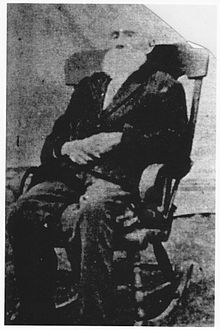 | ||
| James Russell Ivie CHILDREN
|
 | ||
| Eliza McKee Faucett Ivie |
The Following Comes From Mount Pleasant History by Hilda Madsen Longsdorf:
After the burning of Hambleton Settlement, nothing was done so far as it is known towards re-establishing a settlement on Pleasant Creek, until about the middle of August, 1858, shortly after the arrival at Ephraim of the Big Move Caravan; James R. Ivie, Sr., Benjamin E. Clapp, Joseph R. Clement, Isaac Allred, Sr., Reuben W. Allred and Richard Ivie who were chosen at Fort Ephraim as an exploring committee to select a suitable location for a new settlement in the northern part of the valley, decided upon a site on
Pleasant Creek. They returned to Fort Ephraim and stated their
views to the immigrants and others, who had reached Fort Ephraim
to remain over the winter.
A
meeting was called and a petition was drafted, signed by sixty men who were
desirous of locating farther north at the site selected. Not knowing just how
to proceed or what to do, a meeting was called for the purpose of discussing
necessary procedures. After some deliberations, James R. Ivie Sr., Joseph R.
Clement, and Isaac Allred were chosen as a committee to wait upon President
Brigham Young in order to obtain his advice. Afterwards, however, it was deemed
best for James Allred and James R. Ivie Sr. personally to present the petition.
Leaving Fort Ephraim September 2nd, they arrived in Great Salt Lake City on
September 6th. There they met Elder Orson Hyde on the street and at once stated
the purpose of their visit. He kindly escorted them to Pres. Brigham Young's
office. After considering the petition, President Young expressed himself as
perfectly in favor of the new settlement. James R. Ivie stated that the
petitioners were desirous that he, President Young, appoint men to take the
lead. President Young, however, was not desirous of choosing their leaders or
bishop at that time, and drafted the following letter which was sent back with
the committee and presented to the petitioners: "Great
Salt Lake City, Sept. 6, 1858.
"Brother John Reese and the rest of
the brethren whose names are on the list:
"In
am perfectly willing that you should go there (Pleasant Creek) and make a
settlement, but you must consider whether it will be safe or not. You wish to
know my mind on the subject. It is this, that you must build you a good
substantial fort and live in it, use every precaution that is necessary against
the Indians. Your fort must be twelve feet high and four feet thick, built
either of stone or adobe and laid in lime mortar. I also want you to select one
of your number for president and one for bishop. You will have to be very
careful of your stock or you will lose them. In choosing your farming land get
it as nearly together as possible.
A
meeting was called and a petition was drafted, signed by sixty men who were
desirous of locating farther north at the site selected. Not knowing just how
to proceed or what to do, a meeting was called for the purpose of discussing
necessary procedures. After some deliberations, James R. Ivie Sr., Joseph R.
Clement, and Isaac Allred were chosen as a committee to wait upon President
Brigham Young in order to obtain his advice. Afterwards, however, it was deemed
best for James Allred and James R. Ivie Sr. personally to present the petition.
Leaving Fort Ephraim September 2nd, they arrived in Great Salt Lake City on
September 6th. There they met Elder Orson Hyde on the street and at once stated
the purpose of their visit. He kindly escorted them to Pres. Brigham Young's
office. After considering the petition, President Young expressed himself as
perfectly in favor of the new settlement. James R. Ivie stated that the
petitioners were desirous that he, President Young, appoint men to take the
lead. President Young, however, was not desirous of choosing their leaders or
bishop at that time, and drafted the following letter which was sent back with
the committee and presented to the petitioners: "Great
Salt Lake City, Sept. 6, 1858."Brother John Reese and the rest of
the brethren whose names are on the list:
"I am perfectly willing that you should go there (Pleasant Creek) and make a settlement, but you must consider whether it will be safe or not. You wish to know my mind on the subject. It is this, that you must build you a good substantial fort and live in it, use every precaution that is necessary against the Indians. Your fort must be twelve feet high and four feet thick, built either of stone or adobe and laid in lime mortar. I also want you to select one of your number for president and one for bishop. You will have to be very careful of your stock or you will lose them. In choosing your farming land get it as nearly together as possible."
June 20th, 1866, Indians under Chief Black Hawk made a raid on the stock of Scipio. During the skirmish Henry Wright and James R. Ivie, the father of Colonel J. L. Ivie, were killed. It will be remembered that in 1859 James R. Ivie had been chosen at Ephraim as leader for the company of pioneers who settled Mount Pleasant, and that he faithfully filled that position until W. S. Seeley was chosen bishop of the colony. A short time after the killing of Mr. Ivie, a son of Ivie, in retaliation for the killing of his father, killed a friendly Indian. This enraged the Indians and they entered more vigorously in to the bloody work of massacre among the white settlers.
~~~~~~~~~~~~~~~~~~~~~~~~~~~~~~~~~~~~~~~~~~~~~~~~~~~~~~~~~~~~~~~~~~~~~~~~~
Submitted by: Sharon Allred Jessop 06/08/1999
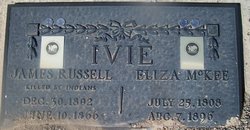
JAMES RUSSELL IVIE & ; WIFE ELIZA MCKEE FAUCETT
Born: December 30, 1802 Born: July 5, 1808
Died: June 10, 1866 Died: August 7, 1861
Sketch of Their Lives By Hettie M. Robins
There is documentary evidence that Ivye, Ivie, Ivy, and Ivey are all of the same family. At the time there were no dictionaries, and the art of spelling was not highly developed. We find that most of the Ivies in the Southern and Eastern states have settled on spelling the name Ivey. We find the Ivey name in the United States as early as 1700. In the Revolutionary War the names of six soldiers are listed from Virginia and nine from North Carolina. In the Civil War there were hundreds, some of them in almost every Southern state and, perhaps, some listed in the Northern States.
Records show a Thomas Ivye or Ivie lived in Gloucestershire, England, about 1425, also of Ives coming to the United States from England as early as 1700, or even before. The above is sort of introductory of the Ivie family, the family tree of which our early grandparents are a branch of James Russell, the son of John Anderson Ivie, who was the sone of Anderson Ivey.
James Russell Ivie, son of John Anderson Ivie and Sarah Allred, daughter of William & Elizabeth Thresher, of North Carolina was born in Franklin County, Georgia, December 8, 1902. He was the second of nine children born to this union.
James Russell married Eliza McKee Faucett. She was born July 5, 1808, at West Columbia, Nuary County, Tennessee, to Richard Faucett and Mary McKee. There were married about June 1824. The location of their marriage is not definitely known, though the belief is that it may have been in Tennessee, since that is where they were living at the time, and their first three children were born, it is evident that they were moving from state to state - - going further west. The family spent from 1830 to 1844 in the State of Missouri, living in Paris, West Paris, and Caldwell Counties. They moved, then, to Council Bluffs, Pottowatamie County, Missouri, where their 11th child was born in 1846. From there they moved to Salt Lake City, where another child was born, and then to Provo, where the next child was born. Thirteen children in all were born to this union.
It was in the early 1830's in Missouri, that the Mormon Missionaries came to the areas in Missouri where the Ivies lived. Parley P. Pratt was one of the elders who came so often to their homes. It was he who brought the Book of Mormon to them and taught them the gospel, which converted them. He also helped to baptize them as members of the Church of Latter-Day Saints. Thereafter, their homes were always homes for the traveling missionaries.
I would like to relate an instance the Great Grandfather told us - - not just once, but many times.
I t happened some years after the Ivies had joined the Church. It was in November 1839, while the Elders were out preaching the Gospel that they were seized and put in prison without a hearing, or a trial. They were held prisoners from November 1839 to July 1940. Among them were Elder Parley P. Pratt, Elder Phelps, and others. The saints had planned a way of freeing the last three missionaries held prisoners. They had been changed from one prison to another during the seven months of confinement. At this time they were in Columbus, Missouri. The plan was worked out as Orson, brother of Parley P. Pratt, and others, had planned it, and happened on the eve of Independence day. The three prisoners, when their evening meal was served, crowded through the door and managed to evade bullets fired at them, and, upon reaching the three horses, brought for them by their brethren, were helped to mount and advised to separate, each going in a different direction, then, to hide themselves, in a deep cave until dark. One of the three was captured and taken back to prison for a short time. Elder Phelps managed to make his escape and reach Illinois, several days later. Elder Pratt was less fortunate and, apparently, headed off in another direction. Finally he made for a vast forest of trees, making his was some distance from his horse to await darkness. He climbed into a huge tree, laid his legs outstretched on top of the branches, locked his arms around two other limbs and, in this way, could not be so easily observed, had anyone come his way. After darkness, when he could no longer hear voices, he came down from his hiding place in the tree and went in search of his horse, which had broken loose and left him to make his way on foot.
On the third day of his escape he found himself in a neighborhood of settlers where he had had some acquaintances years previously, and where once there had been a small branch of the church; but, the saints had moved west, having been driven out of the state with other members of their faith. Elder Pratt remembered there were families of Ivies who had lived on the road, and in some clearing in the timber; so, he decided to make his way to them, and told us, in his own works as follows:
Quote: “ I was not sure if they were still friendly with the church, or if they had turned from it to avoid violence and being driven out. I hesitated, then decided to ask help from my Father in Heaven. I arose to my feet feeling much better. I asked in my prayers, that as I passed by the house, if they were still my friends, I would be recognized - - if not, that I might pass peaceably by. As I walked past their home that Sunday evening, about two hours before sundown, I got nearly by when the children playing in the front yard discovered me and cried out with surprise and much joy: “ There is Brother Pratt.” At this, a young man came running out to me who proved to be one of my acquaintances, still a member of the church, and who had been driven with others from the upper valley. Instead of going to Illinois, he had come back to his old neighborhood. I asked about Mr. Ivy and he said that he and his wife had gone to a neighbor’s home two or three miles away. He said “I am here on a visit.” He also advised that they had just received the news of my escape and were sending out warnings to be on the lookout. I told him of my plight. I was hungry and faint and my feet were covered with blisters. He told me of his brother’s wives and children who were also driven out of upper valley and were living in an obscure place in the woods, while the young man went in to see if it was all right. He came back with milk, cream, and bread. I ate of this and then went to the house. The wife said her husband would soon be home. I told her I was in constant fear of being found. She instructed the children not to say one word if anyone came, but to act like I was a total stranger. It was well she did, for just then a man came inquiring for her husband. She told him he was away and to come back but he said it was a matter of business he wanted to see her husband about and would wait. After an hour the dog barked and they knew her husband was returning. The children rushed out to see their father, and to tell him not to recognize me, as there was a strange young man there to see him. As he came in he gave me a cold look and a “howdy stranger, “ and turned to the other fellow. He was quite friendly with him. The young fellow told the man of the house he had some business with him and would he step out for awhile. He had come to borrow his saddle. As soon as he had gone the man of the house came in and threw his arms around my neck and welcomed me to his house. We ate supper and I asked if he would exchange hats with me as it had been winter when we were arrested. He gave me a hat that fully disguised me. The good wife made a lunch for me and Brother Ivie placed his wife’s saddle on her horse. After farewells to his wife and brother we were soon on our way. He went with me until I was safe - - way after midnight. He bade me God speed and returned to his family.” Unquote
This man and wife were James Russell Ivie and his wife, Eliza. I heard this story many times from Great Grandma and her son, Grandpa Ivie. Only, as I remember it, the side saddle and his horse got him well on his way, but the horse never found his way back.
I remember Grandmother telling: “I would go through the timber to a small spring for a pail of water. I was so frightened - - I could often hear the plaintiff cry of a panther or ‘panter’, as grandmother called it.
James Russell Ivie and Grandmother: Just where they met we don’t know. This is the tale she told, only it has lost its soft southern accent that was so pleasing in the way she would tell it: “I was milking my father’s cow one evening, the first time pop came a‘calling on me. He says, Eliza I’ve come a’ courting you. I looked up and there I saw a boy, plenty big enough to be wearing britches, and there he stood with a doe shirt on. I told him right out if I was to be his girl he better go home and ask his mother to make him some britches. The next time he came he wore britches.” (This was taken from Grandparents’ Martin and Martha Ivie’s family record.) His father John Anderson Ivie, owned a large tract of land, or plantation, and with 75 Negroes on it as slaves. When his son James Russell, and family left to join the saints to come west, his father gave him a little Negro boy. He was old enough to help Grandma with the smaller children. When they reached Omaha and near getting their outfits ready to start out, they were told not to burden themselves with extra mouths to feed, other than their families. So Grandpa, James Russell, gave the little boy his freedom and told him he could go to live with another family, or find his way back to his family. As they left, the little fellow cried and said, “Who will take of Missy, Betsy and Marie, I do love you Mama Ivie.” Both Grandmother and Grandfather loved the Negro boy and hated leaving him behind.
It was in the spring of 1848 in the month of May that the Ivies, James Russell, his wife and nine of their 11 children began plans for moving westward. Two of his sons were with the Mormon Battalion. Besides James Russell and family, two of his brothers, Thomas Isaac, or Kelton, and William Shelton, and families , got as far as Nerrion, Missouri, on their way to joint the wagon train which would have soon headed for the west (Utah). So they dropped out of the company. There was something about one of William’s girls marrying as a plural wife to a man by the name of Long. Both parents strongly opposed the marriage.
It was on the first of June 1948, that the Ivies left Elkhorn in the company of the saints - - 1,229 souls and 397 wagons, headed for the Great Salt Lake Valley. They were in Brigham Young’s second company. The Allred family, also, came at this time. Grandfather’s outfit was well equipped with a good wagon and teams. His son’s Richard’s wife, Elizabeth Dobson, was with them. The trip across the plains and mountains was made about the same as most of them in the company. Great Grandmother helped in cases of sickness and births in their company as well as others, where ever they were needed on their trip to Utah. The pioneers reached Great Salt Lake Valley about September 20, 1848. They must have spent the winter in Salt Lake City, for on February 25, 1849. Grandma gave birth to a son whom they called Hyrum Lewis Ivie. From Salt Lake City they went to what was then called Rhodes, or Roade Valley, and later called Provo Valley. Here another son was born, November 19, 1852. He was named Heber Charles Ivie. Their eighth child, a son, named Joseph Ivie died the year before in 1851. He was 11 years old at the time.
From Provo Valley some of the Ivie family went to Weber County to what is now Kamas. However, they weren’t satisfied with the outlook there, so they left and came to Mt. Pleasant. They had relatives there for a few years. During the time they were in Mt. Pleasant and the time they came to Round Valley (Scipio) in 1863, James Russell and some of his family and the Allred Family, made a trip to Rose Valley, Nevada, with the expectations of locating there. The Valley didn’t meet their expectations - - others having already located there. They came back to Scipio in the late spring of 1863. At that time the settlers were still in Graball or Robinville, where there was a branch of the church, the Ivies didn’t go there to make their home, but went a little further south, up the valley about two miles from Graball. This was where a little stream of water came from a small lake about seven or eight miles further south in the Valley. It separated into two streams. The west stream went by the settlers at Graball, the east stream just running to waste. It was on the east fork that James Russell and family stopped. It was known as Ivie Creek for years. Not long after this, President Young visited the people here, and advised them to locate closer together on a townsite in the Valley. It was called Rourl Valley, but later changed to Scipio.
The Ivies were the first to build homes on the new townsite. The first home built was a room put up of logs - - it was the old stable of the Joe Miller lot, built by William Franklin Ivie, a son of James Russell. His family lived there until he could get logs out to build a place for them to live in. This stable was used to keep a fine stallion in. He had it brought here with the livestock, horse and cattle. Grandfather James Russell built his home and they owned the old Joseph Stone lot - -it is on the northwest corner from the public square. In reading the record kept by the Branch Clerk, John Memmott, we find James Russell Ivie was interested both in his church and civil affairs. Both he and his son, William Franklin, were block teachers, and James Russell was President of the Field Committee, and Water Master. He was also very interested in education. He helped with the loan of his teams to move the log school house from Graball to the new homesite.
In the spring and summer of 1866 the Indians had become very hostile, and on the warpath; making raids on the stock owned by the settlers. A large band of Indians under Chief Black Hawk made a raid on a Sunday Morning, June 10, 1866, when Grandfather James Russell’s favorite milk cow was to freshen. Grandfather rose early and walked down to the pasture lands a little north and west of the settlement, in what was called the pond field. As he neared the spot where the cow was, he heard an Indian War Hoop and the people in town also heard it. They rushed out to look for Grandfather and found his body already pierced by several arrows. He was stripped of his clothing, all but his boots, as they were unable to get them off. The Indians made off with the cattle and horses owned by the families.
Both Grandparents had received their patriarchal blessings. I can remember so well, seeing dear little Grandma going to the old black box, or chest, as she called it. She would reach in, bring out her blessing, hand it to mother, and ask her to read it. It seemed such a source of strength and comfort to her in her last days. The one thing I remember in it, was that their posterity should be as Jacob’s of old, and as numerous as the sands of the sea. Of their 13 children, 12 grew to maturity, marrying, and are parents of large families. A host of grandchildren, some over 125 in number. I am happy to be counted among their great-grandchildren.
History obtained form Loya Moscon, 1888 E. Spring Creek Dr, Bountiful, Utah 84810
My records show that James Russell Ivie is the first born child of Anderson Ivie and Sarah Allred. James Anderson Ivie is the second child of James Russell and Sarah.
I have records of deeds and Anderson Ivie is the name shown on these. F.P.
Hettie M Robins gives us the following description of Eliza M Ivie’s last years.
“After the death of her husband, the care of Eliza fell on the shoulders of her son Martin and his wife, Martha Ivie. Her son moved a one-room log house onto his lot so his mother would be near them. When her son bought a larger home his mother was given a large sunny room to live in. I imagine I see it now with its fireplace and one or two pots hanging from hooks over the flames of coals. There was a very small cook stove in the corner. Her table was next to the fireplace. Just under the window was the large black box or chest that came across the plains with them. Next was the four-poster bed with rawhide stripes crisscrossed for slats or springs. The floor and hearth were scrubbed clean enough to eat on. White short curtains were at the windows The white cover on the black box and cover over the bed pillows all with knotted edging and made out of course white cotton yarn. I remember her telling everyone once that although she was dead and laid out of the cooling board, she said, "But I fooled them, I came back to life again because my mission on earth was not finished." She would sometimes get a little out-of-sorts at some of our pranks and say: "If you youngans don't behave yourselves when I die I will come back and haunt ye."
"Both Grandparents had received their patriarchal blessings. I can remember so well, seeing dear little Grandma going to the old black box, or chest, as she called it. She would reach in, bring out her blessing, hand it to mother, and ask her to read it. It seemed such a source of strength and comfort to her in her last days. The one thing I remember in it, was that their posterity should be as Jacob's of old, and as numerous as the sands of the sea. Of their 13 children, 12 grew to maturity, marrying and are parents of large families. A host of grandchildren, some over 125 in number. I am happy to be counted among their great-grandchildren."
Friday, March 1, 2013


Subscribe to:
Posts (Atom)