Showing posts with label Ivie. Show all posts

Friday, May 1, 2026

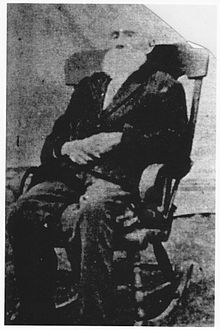
James Russell Ivie and Eliza McKee Faucett ~~~ Pioneers of the Month ~~~ May 2026


James Russell Ivie


CHILDREN
Richard Anderson Ivie
William Franklin Ivie
Sarah A Ivie
James Alexander Ivie
John Lehi Ivie
Polly Ann Ivie
Elizabeth Caroline Ivie
Joseph Orson Ivie   (11yrs)
Eliza Marie Ivie
Mari Betsy Ivie      (0yrs)
Isaac Thomas Ivie
Benjamin Martin Ivie
Hyrum Lewis Ivie
Heber Kimball Ivie
Martha Adeline Ivie (12yrs)
1825 - 1892
1826 - 1880
1829 - 1890
1830 - 1906
1833 - 1909
1835 - 1896
1837 - 1901
1840 - 1851
1842 - 1920
1842 - 1842
1844 - 1906
1846 - 1926
1849 - 1927
1852 - 1923
1855 - 1867


Eliza McKee Faucett Ivie


The Following Comes From Mount Plea
sant History by Hilda Madsen Longsdorf:

After the burning of Hambleton Settlement, nothing was done so far as it is known towards re-establishing a settlement on Pleas­ant Creek, until about the middle of August, 1858, shortly after the arrival at Ephraim of the Big Move Caravan; James R. Ivie, Sr., Benjamin E. Clapp, Joseph R. Clement, Isaac Allred, Sr., Reuben W. Allred and Richard Ivie who were chosen at Fort Ephraim as an exploring committee to select a suitable location for a new settlement in the northern part of the valley, decided upon a site on

 Pleasant Creek. They returned to Fort Ephraim and stated their 

views to the immigrants and others, who had reached Fort Ephraim 

to remain over the winter.


A meeting was called and a petition was drafted, signed by sixty men who were desirous of locating farther north at the site selected. Not knowing just how to proceed or what to do, a meet­ing was called for the purpose of discussing necessary procedures. After some deliberations, James R. Ivie Sr., Joseph R. Clement, and Isaac Allred were chosen as a committee to wait upon Presi­dent Brigham Young in order to obtain his advice. Afterwards, however, it was deemed best for James Allred and James R. Ivie Sr. personally to present the petition. Leaving Fort Ephraim September 2nd, they arrived in Great Salt Lake City on September 6th. There they met Elder Orson Hyde on the street and at once stated the purpose of their visit. He kindly escorted them to Pres. Brigham Young's office. After considering the petition, President Young expressed himself as perfectly in favor of the new settle­ment. James R. Ivie stated that the petitioners were desirous that he, President Young, appoint men to take the lead. President Young, however, was not desirous of choosing their leaders or bishop at that time, and drafted the following letter which was sent back with the committee and presented to the petitioners: "Great Salt Lake City, Sept. 6, 1858.
"Brother John Reese and the rest of
the brethren whose names are on the list:
"In am perfectly willing that you should go there (Pleasant Creek) and make a settlement, but you must consider whether it will be safe or not. You wish to know my mind on the subject. It is this, that you must build you a good substantial fort and live in it, use every precaution that is necessary against the Indians. Your fort must be twelve feet high and four feet thick, built either of stone or adobe and laid in lime mortar. I also want you to select one of your number for president and one for bishop. You will have to be very careful of your stock or you will lose them. In choosing your farming land get it as nearly together as possible.

A meeting was called and a petition was drafted, signed by sixty men who were desirous of locating farther north at the site selected. Not knowing just how to proceed or what to do, a meet­ing was called for the purpose of discussing necessary procedures. After some deliberations, James R. Ivie Sr., Joseph R. Clement, and Isaac Allred were chosen as a committee to wait upon Presi­dent Brigham Young in order to obtain his advice. Afterwards, however, it was deemed best for James Allred and James R. Ivie Sr. personally to present the petition. Leaving Fort Ephraim September 2nd, they arrived in Great Salt Lake City on September 6th. There they met Elder Orson Hyde on the street and at once stated the purpose of their visit. He kindly escorted them to Pres. Brigham Young's office. After considering the petition, President Young expressed himself as perfectly in favor of the new settle­ment. James R. Ivie stated that the petitioners were desirous that he, President Young, appoint men to take the lead. President Young, however, was not desirous of choosing their leaders or bishop at that time, and drafted the following letter which was sent back with the committee and presented to the petitioners: "Great Salt Lake City, Sept. 6, 1858.
"Brother John Reese and the rest of
the brethren whose names are on the list:


"I am perfectly willing that you should go there (Pleasant Creek) and make a settlement, but you must consider whether it will be safe or not. You wish to know my mind on the subject. It is this, that you must build you a good substantial fort and live in it, use every precaution that is necessary against the Indians. Your fort must be twelve feet high and four feet thick, built either of stone or adobe and laid in lime mortar. I also want you to select one of your number for president and one for bishop. You will have to be very careful of your stock or you will lose them. In choosing your farming land get it as nearly together as possible."

June 20th, 1866, Indians under Chief Black Hawk made a raid on the stock of Scipio. During the skirmish Henry Wright and James R. Ivie, the father of Colonel J. L. Ivie, were killed. It will be remembered that in 1859 James R. Ivie had been chosen at Ephraim as leader for the company of pioneers who settled Mount Pleasant, and that he faithfully filled that position until W. S. Seeley was chosen bishop of the colony. A short time after the killing of Mr. Ivie, a son of Ivie, in retaliation for the killing of his father, killed a friendly Indian.  This enraged the Indians and they entered more vigorously in to the bloody work of massacre among the white settlers.

~~~~~~~~~~~~~~~~~~~~~~~~~~~~~~~~~~~~~~~~~~~~~~~~~

Eliza McKee Faucett Ivie


Submitted by: Sharon Allred Jessop 06/08/1999
JAMES RUSSELL IVIE & ; WIFE ELIZA MCKEE FAUCETT

Born: December 30, 1802 Born: July 5, 1808
Died: June 10, 1866 Died: August 7, 1861

Sketch of Their Lives By Hettie M. Robins

There is documentary evidence that Ivye, Ivie, Ivy, and Ivey are all of the same family. At the time there were no dictionaries, and the art of spelling was not highly developed. We find that most of the Ivies in the Southern and Eastern states have settled on spelling the name Ivey. We find the Ivey name in the United States as early as 1700. In the Revolutionary War the names of six soldiers are listed from Virginia and nine from North Carolina. In the Civil War there were hundreds, some of them in almost every Southern state and, perhaps, some listed in the Northern States.

Records show a Thomas Ivye or Ivie lived in Gloucestershire, England, about 1425, also of Ives coming to the United States from England as early as 1700, or even before. The above is sort of introductory of the Ivie family, the family tree of which our early grandparents are a branch of James Russell, the son of John Anderson Ivie, who was the sone of Anderson Ivey.

James Russell Ivie, son of John Anderson Ivie and Sarah Allred, daughter of William & Elizabeth Thresher, of North Carolina was born in Franklin County, Georgia, December 8, 1902. He was the second of nine children born to this union.

James Russell married Eliza McKee Faucett. She was born July 5, 1808, at West Columbia, Nuary County, Tennessee, to Richard Faucett and Mary McKee. There were married about June 1824. The location of their marriage is not definitely known, though the belief is that it may have been in Tennessee, since that is where they were living at the time, and their first three children were born, it is evident that they were moving from state to state - - going further west. The family spent from 1830 to 1844 in the State of Missouri, living in Paris, West Paris, and Caldwell Counties. They moved, then, to Council Bluffs, Pottowatamie County, Missouri, where their 11th child was born in 1846. From there they moved to Salt Lake City, where another child was born, and then to Provo, where the next child was born. Thirteen children in all were born to this union.

It was in the early 1830's in Missouri, that the Mormon Missionaries came to the areas in Missouri where the Ivies lived. Parley P. Pratt was one of the elders who came so often to their homes. It was he who brought the Book of Mormon to them and taught them the gospel, which converted them. He also helped to baptize them as members of the Church of Latter-Day Saints. Thereafter, their homes were always homes for the traveling missionaries.

I would like to relate an instance the Great Grandfather told us - - not just once, but many times.

I t happened some years after the Ivies had joined the Church. It was in November 1839, while the Elders were out preaching the Gospel that they were seized and put in prison without a hearing, or a trial. They were held prisoners from November 1839 to July 1940. Among them were Elder Parley P. Pratt, Elder Phelps, and others. The saints had planned a way of freeing the last three missionaries held prisoners. They had been changed from one prison to another during the seven months of confinement. At this time they were in Columbus, Missouri. The plan was worked out as Orson, brother of Parley P. Pratt, and others, had planned it, and happened on the eve of Independence day. The three prisoners, when their evening meal was served, crowded through the door and managed to evade bullets fired at them, and, upon reaching the three horses, brought for them by their brethren, were helped to mount and advised to separate, each going in a different direction, then, to hide themselves, in a deep cave until dark. One of the three was captured and taken back to prison for a short time. Elder Phelps managed to make his escape and reach Illinois, several days later. Elder Pratt was less fortunate and, apparently, headed off in another direction. Finally he made for a vast forest of trees, making his was some distance from his horse to await darkness. He climbed into a huge tree, laid his legs outstretched on top of the branches, locked his arms around two other limbs and, in this way, could not be so easily observed, had anyone come his way. After darkness, when he could no longer hear voices, he came down from his hiding place in the tree and went in search of his horse, which had broken loose and left him to make his way on foot.

On the third day of his escape he found himself in a neighborhood of settlers where he had had some acquaintances years previously, and where once there had been a small branch of the church; but, the saints had moved west, having been driven out of the state with other members of their faith. Elder Pratt remembered there were families of Ivies who had lived on the road, and in some clearing in the timber; so, he decided to make his way to them, and told us, in his own works as follows:

Quote: “ I was not sure if they were still friendly with the church, or if they had turned from it to avoid violence and being driven out. I hesitated, then decided to ask help from my Father in Heaven. I arose to my feet feeling much better. I asked in my prayers, that as I passed by the house, if they were still my friends, I would be recognized - - if not, that I might pass peaceably by. As I walked past their home that Sunday evening, about two hours before sundown, I got nearly by when the children playing in the front yard discovered me and cried out with surprise and much joy: “ There is Brother Pratt.” At this, a young man came running out to me who proved to be one of my acquaintances, still a member of the church, and who had been driven with others from the upper valley. Instead of going to Illinois, he had come back to his old neighborhood. I asked about Mr. Ivy and he said that he and his wife had gone to a neighbor’s home two or three miles away. He said “I am here on a visit.” He also advised that they had just received the news of my escape and were sending out warnings to be on the lookout. I told him of my plight. I was hungry and faint and my feet were covered with blisters. He told me of his brother’s wives and children who were also driven out of upper valley and were living in an obscure place in the woods, while the young man went in to see if it was all right. He came back with milk, cream, and bread. I ate of this and then went to the house. The wife said her husband would soon be home. I told her I was in constant fear of being found. She instructed the children not to say one word if anyone came, but to act like I was a total stranger. It was well she did, for just then a man came inquiring for her husband. She told him he was away and to come back but he said it was a matter of business he wanted to see her husband about and would wait. After an hour the dog barked and they knew her husband was returning. The children rushed out to see their father, and to tell him not to recognize me, as there was a strange young man there to see him. As he came in he gave me a cold look and a “howdy stranger, “ and turned to the other fellow. He was quite friendly with him. The young fellow told the man of the house he had some business with him and would he step out for awhile. He had come to borrow his saddle. As soon as he had gone the man of the house came in and threw his arms around my neck and welcomed me to his house. We ate supper and I asked if he would exchange hats with me as it had been winter when we were arrested. He gave me a hat that fully disguised me. The good wife made a lunch for me and Brother Ivie placed his wife’s saddle on her horse. After farewells to his wife and brother we were soon on our way. He went with me until I was safe - - way after midnight. He bade me God speed and returned to his family.” Unquote

This man and wife were James Russell Ivie and his wife, Eliza. I heard this story many times from Great Grandma and her son, Grandpa Ivie. Only, as I remember it, the side saddle and his horse got him well on his way, but the horse never found his way back.

I remember Grandmother telling: “I would go through the timber to a small spring for a pail of water. I was so frightened - - I could often hear the plaintiff cry of a panther or ‘panter’, as grandmother called it.

James Russell Ivie and Grandmother: Just where they met we don’t know. This is the tale she told, only it has lost its soft southern accent that was so pleasing in the way she would tell it: “I was milking my father’s cow one evening, the first time pop came a‘calling on me. He says, Eliza I’ve come a’ courting you. I looked up and there I saw a boy, plenty big enough to be wearing britches, and there he stood with a doe shirt on. I told him right out if I was to be his girl he better go home and ask his mother to make him some britches. The next time he came he wore britches.” (This was taken from Grandparents’ Martin and Martha Ivie’s family record.) His father John Anderson Ivie, owned a large tract of land, or plantation, and with 75 Negroes on it as slaves. When his son James Russell, and family left to join the saints to come west, his father gave him a little Negro boy. He was old enough to help Grandma with the smaller children. When they reached Omaha and near getting their outfits ready to start out, they were told not to burden themselves with extra mouths to feed, other than their families. So Grandpa, James Russell, gave the little boy his freedom and told him he could go to live with another family, or find his way back to his family. As they left, the little fellow cried and said, “Who will take of Missy, Betsy and Marie, I do love you Mama Ivie.” Both Grandmother and Grandfather loved the Negro boy and hated leaving him behind.

It was in the spring of 1848 in the month of May that the Ivies, James Russell, his wife and nine of their 11 children began plans for moving westward. Two of his sons were with the Mormon Battalion. Besides James Russell and family, two of his brothers, Thomas Isaac, or Kelton, and William Shelton, and families , got as far as Nerrion, Missouri, on their way to joint the wagon train which would have soon headed for the west (Utah). So they dropped out of the company. There was something about one of William’s girls marrying as a plural wife to a man by the name of Long. Both parents strongly opposed the marriage.

It was on the first of June 1948, that the Ivies left Elkhorn in the company of the saints - - 1,229 souls and 397 wagons, headed for the Great Salt Lake Valley. They were in Brigham Young’s second company. The Allred family, also, came at this time. Grandfather’s outfit was well equipped with a good wagon and teams. His son’s Richard’s wife, Elizabeth Dobson, was with them. The trip across the plains and mountains was made about the same as most of them in the company. Great Grandmother helped in cases of sickness and births in their company as well as others, where ever they were needed on their trip to Utah. The pioneers reached Great Salt Lake Valley about September 20, 1848. They must have spent the winter in Salt Lake City, for on February 25, 1849. Grandma gave birth to a son whom they called Hyrum Lewis Ivie. From Salt Lake City they went to what was then called Rhodes, or Roade Valley, and later called Provo Valley. Here another son was born, November 19, 1852. He was named Heber Charles Ivie. Their eighth child, a son, named Joseph Ivie died the year before in 1851. He was 11 years old at the time.

From Provo Valley some of the Ivie family went to Weber County to what is now Kamas. However, they weren’t satisfied with the outlook there, so they left and came to Mt. Pleasant. They had relatives there for a few years. During the time they were in Mt. Pleasant and the time they came to Round Valley (Scipio) in 1863, James Russell and some of his family and the Allred Family, made a trip to Rose Valley, Nevada, with the expectations of locating there. The Valley didn’t meet their expectations - - others having already located there. They came back to Scipio in the late spring of 1863. At that time the settlers were still in Graball or Robinville, where there was a branch of the church, the Ivies didn’t go there to make their home, but went a little further south, up the valley about two miles from Graball. This was where a little stream of water came from a small lake about seven or eight miles further south in the Valley. It separated into two streams. The west stream went by the settlers at Graball, the east stream just running to waste. It was on the east fork that James Russell and family stopped. It was known as Ivie Creek for years. Not long after this, President Young visited the people here, and advised them to locate closer together on a townsite in the Valley. It was called Rourl Valley, but later changed to Scipio.

The Ivies were the first to build homes on the new townsite. The first home built was a room put up of logs - - it was the old stable of the Joe Miller lot, built by William Franklin Ivie, a son of James Russell. His family lived there until he could get logs out to build a place for them to live in. This stable was used to keep a fine stallion in. He had it brought here with the livestock, horse and cattle. Grandfather James Russell built his home and they owned the old Joseph Stone lot - -it is on the northwest corner from the public square. In reading the record kept by the Branch Clerk, John Memmott, we find James Russell Ivie was interested both in his church and civil affairs. Both he and his son, William Franklin, were block teachers, and James Russell was President of the Field Committee, and Water Master. He was also very interested in education. He helped with the loan of his teams to move the log school house from Graball to the new homesite.

In the spring and summer of 1866 the Indians had become very hostile, and on the warpath; making raids on the stock owned by the settlers. A large band of Indians under Chief Black Hawk made a raid on a Sunday Morning, June 10, 1866, when Grandfather James Russell’s favorite milk cow was to freshen. Grandfather rose early and walked down to the pasture lands a little north and west of the settlement, in what was called the pond field. As he neared the spot where the cow was, he heard an Indian War Hoop and the people in town also heard it. They rushed out to look for Grandfather and found his body already pierced by several arrows. He was stripped of his clothing, all but his boots, as they were unable to get them off. The Indians made off with the cattle and horses owned by the families.

Both Grandparents had received their patriarchal blessings. I can remember so well, seeing dear little Grandma going to the old black box, or chest, as she called it. She would reach in, bring out her blessing, hand it to mother, and ask her to read it. It seemed such a source of strength and comfort to her in her last days. The one thing I remember in it, was that their posterity should be as Jacob’s of old, and as numerous as the sands of the sea. Of their 13 children, 12 grew to maturity, marrying, and are parents of large families. A host of grandchildren, some over 125 in number. I am happy to be counted among their great-grandchildren.

History obtained form Loya Moscon, 1888 E. Spring Creek Dr, Bountiful, Utah 84810

My records show that James Russell Ivie is the first born child of Anderson Ivie and Sarah Allred. James Anderson Ivie is the second child of James Russell and Sarah.

I have records of deeds and Anderson Ivie is the name shown on these. F.P.

Hettie M Robins gives us the following description of Eliza M Ivie’s last years.
“After the death of her husband, the care of Eliza fell on the shoulders of her son Martin and his wife, Martha Ivie. Her son moved a one-room log house onto his lot so his mother would be near them. When her son bought a larger home his mother was given a large sunny room to live in. I imagine I see it now with its fireplace and one or two pots hanging from hooks over the flames of coals. There was a very small cook stove in the corner. Her table was next to the fireplace. Just under the window was the large black box or chest that came across the plains with them. Next was the four-poster bed with rawhide stripes crisscrossed for slats or springs. The floor and hearth were scrubbed clean enough to eat on. White short curtains were at the windows The white cover on the black box and cover over the bed pillows all with knotted edging and made out of course white cotton yarn. I remember her telling everyone once that although she was dead and laid out of the cooling board, she said, "But I fooled them, I came back to life again because my mission on earth was not finished." She would sometimes get a little out-of-sorts at some of our pranks and say: "If you youngans  don't behave yourselves when I die I will come back and haunt ye."
"Both Grandparents had received their patriarchal blessings. I can remember so well, seeing dear little Grandma going to the old black box, or chest, as she called it. She would reach in, bring out her blessing, hand it to mother, and ask her to read it. It seemed such a source of strength and comfort to her in her last days. The one thing I remember in it, was that their posterity should be as Jacob's of old, and as numerous as the sands of the sea. Of their 13 children, 12 grew to maturity, marrying and are parents of large families. A host of grandchildren, some over 125 in number. I am happy to be counted among their great-grandchildren."


Wednesday, April 30, 2025

ISAAC THOMAS IVIE AND ELIZABETH EVANS IVIE ~~~PIONEERS OF THE MONTH ~~~ MAY 2025


L to R: Back Row: Maurice Earl, Florencc Isabel, James Evan, Edith May, Justin Thomas, Lula Clara ,

Front row: Edna Elizabeth, Isaac Thomas, Marjory, Elizabeth Evans, Robert Elmo, 


Monday, May 1, 2017

Elisha Kembur Barton and Celestial Eliza McArthur ~ Pioneers of the Month ~ May 2017


Celestial Eliza McArthur got the name "Eliza" from her mother, Eliza Rebecca Scovil, who had been named for her Mother's first cousin, Eliza R. Snow. Celestail's grandmother, Lury Snow, was daughter of Franklin Snow and Lydia Alcott. Franklin was a brother of Oliver, father of the prophet of Lorenzo Snow, and his sister, Eliza R. Snow. Celestial Eliza McArthur, daughter of Duncun McArthur an Eliza Rebecca Scovil, was born in Pleasant Grove, Utah, on February 10, 1860. She was the oldest of four daughters in the second family of Duncun McArthur, three of whom lived.
Duncan McArthur


There had been fourteen children in the first family, five of whom lived. Grandmother was actually part of four different families. She was half-sister to her father's first family; to her step-father's family by his first wife; and to his second family by her mother as well as being a member of her father's second family. Since she as the oldest in a large family, she grew up used to responsibility and hard work. Her step-father, Washington Perry McArthur, who was also her half-brother, was first counselor to Bishop W.S. Seely when the first ward was organized in Mt. Pleasant in July 1859. He was also active in the town government. Elisha Kembur Barton, son of John Barton and Susannah Wilkinson Barton, was born December 22, 1856, in Bountiful, Davis County, Utah. He was the youngest child in a family of eight children--four boys and four girls.


The other children--in order of their birth--were: Mary Catherine, William Gilbert, Elizabeth Jane, Phebe Elen, John Oscar, Emely Alice, and Sylvester Aaron. At age 16, Celestial married Elisha Kembur Barton, age 20, son of other early settlers in Mt. Pleasant, John Barton and Susannah Wilkinson. They, too, had joined the saints form Northumberland County, Pennsylvania, in the early days of the Church, and suffered persecutions and hardships before coming with the company led by Brigham Young across the plains to Utah. IN 1850, Brigham Young asked the Barton family to settle in Bountiful, Davis County, Utah, near Salt Lake City. They lived there nearly ten years, during which time their three youngest children were born, including Grandpa Elisha K. Barton, their youngest.
John Ivie 

After John Ivie of Mt. Pleasant met and married Grandpa’s (Elisha’s) oldest sister, they decided water was more plentiful in Mt. Pleasant, and that farming would be better there. They came there in the year 1860. Most of the people were living in the fort then. Mt. Pleasant had been settled only a year. Celestial Eliza McArthur and Elisha Kembur Barton were married on the 29th of November, 1876, in Mt. Pleasant. They went to Salt Lake City and were married, or sealed, in the Endowment House, a little over a year later, on March 14, 1878. They made their home in Mt. Pleasant.

 For a while they lived on Main Street, until they moved down on the 20 acres of farmland, where they stayed for several years. Later, when their family was larger, they built a large red brick home close to the center of town, on e block east on Main Street. The children helped with the building of this home. They stayed there until their children were grown, and and until both of them passed away. 

I will describe it as I remember it. The Plan of this home was a good for the rearing of a large family. There was a huge square kitchen on the southeast with a handy little pantry just off the south side. A nice south window let in sun just about the sink in this well-arranged pantry, where Grandma kept her dishes, utensils, and equipment for cooking. A small, but complete bathroom was just off the kitchen in the southeast corner, and a big window, which was on the east, gave them lots of sunshine. There was a large dining room, which was used more for a living and sitting room than anything else, on the west side of the kitchen. We would call it a family room today. A large bay window on the south side of this room was always filled with beautiful green plants, ferns, and flowers. There was a parlor on the northwest, and a bedroom on the northeast. The parlor contained a piano and an organ, which were used frequently by this music-loving family. On the west side of the dining room was a porch that led to lawns and fruit trees surrounding the house. 

There was a huge garden spot, and a place for cows, horses, chickens, and pigs. Leading from the kitchen on the north was a hallway which led to the upstairs and to the basement room. The upstairs had three large bedrooms and a balcony porch off on of them, on the west side. These rooms were not only used by the children, but by relatives, and guests. The basement room, well finished with brick, was a good, cool, place for the storage of fruits, vegetables, and meats. The walls were flat rocks. 

Thirteen children were born to them--six boys and seven girls. They were-- in order of their birth--Offa Celestial (who died when she was fourteen months old from choking on a pit), Alice Loretta, Kembur LeRoy, Henry Lawrence (my father), John Amos, Noah (who died two days after birth, from an overdose of paregoric), Eva Eliza, Williard “W” (named from a story in the “Juvenile Instructor”), Lloyd McArthur, Hazel Ermina, Sarah Elizabeth, Susan Mildred, and Grace Adelaide. Shortly after Kembur and Celestial were married, he took a load of wheat to Salt Lake in a wagon drawn by two yoke of oxen. Then he bought a charter oak stove, which was about half the size of an ordinary cooking stove of later days. They considered it very fine. Cedar wood, from the cedar hills, was used to burn in it. There was no coal then. People hauled wood all winter long, while the snow was deep. They pulled trees down with oxen, or cut them down. Sylvester and Kembur had their farms together, and worked together for years, until Kembur’s boys, Roy, Lawrence, and Amos, became older, and wanted their farm separate. 

Grandpa Kembur Barton was a good farmer and stockman and a very hard worker. He is always had a nice herd of cattle. Like the Bartons before and after him, he loved good well-bred horses, and always kept an excellent team. For seven generations, the Bartons had been farmers. At one time, Grandpa owned a large sheep herd, but sold it and went into the creamery business. He and his family gathered milk and cream all around town. Celestial, first person at the left in row three, is shown with other members of the “Sunshine Club,” an organization similar to the Relief Society.
Sunshine Club


Retty is second to the right of the man in the back row. The third child from the right in the first row looks like Grace. Grandpa was a short, stocky-built man, 5 feet 6 inches tall, with black curly hair, and grayish blue eyes. He was a natural-born musician. After hearing any tune two or three times, he could play it well on his accordion. He played his accordion frequently for the old time dances they had. He also played the harmonica, and chorded on the organ for the whole family to gather ‘round and sing.’

 They had many happy times together as a family. Most of the children were talented in music. All of them had the natural talent to sing well, as did their mother. Willard stood on the stage when he was three years old, and played tunes on the harmonica. Perhaps the thing I remember most about family gatherings was the brothers and sisters gathering around the piano and singing many beautiful songs. I love the harmony and the rich soprano voices. 

Briant Jacobs told me some time ago how he remembered my Grandmother and the way she bore her testimony in the ward. She would go up to the piano, pick up the hymn book, and sing a favorite hymn, then return to her seat without saying a word. One hymn that she sang was “I Know That My Redeemer Lives.” Grandma proved to be a wonderful homemaker and helpmate. She was very skillful and economical at managing the home under any conditions. She was an excellent cook, housekeeper, and seamstress. 

The whole house reflected not only good housekeeping, but the expert handiwork of Grandma and her girls. There were nice covers on the couches, beautiful cushions, and a general feeling of comfort and well-being, as well as orderliness throughout the house. Grandma seemed to possess an ability to make little go far. She made several hundred quilts, which were skillfully done, from scraps of material. She did a great deal of sewing of clothing and other articles. She was efficient in all that she did, and could accomplish a great deal of work in a minimum amount of time. Many people have told me that she could whip up a meal faster and better than anyone they had ever seen. Grace said that she never saw her mother come to the breakfast table without her hair combed and a clean apron. 

Every tramp that came into town stopped at Grandma’s house to be fed. SHe would fix lunch for them while they chopped an armful of wood. Grandma kept boarders part of the time to help feed the family. She and the family sold butter and milk. The children used to pick and help dry apples up at Aunt Lib’s (Libby Everett, Will Everett’s wife) for their family and Aunt Lib’s. They took care of lodge halls also.

 Grandma spent part of her time as a nurse caring for the sick people around town and she went over to the Jacobs family (just through the block) who were all down with flu and helped them. She also helped to bring Dr. Bryant Jacobs into the world. When his mother was having a difficult delivery, Grandma retired to an upstairs bedroom to pray, and came back down to complete the delivery. Everything went better after that and Sister Jacobs was able to successfully deliver her youngest child. Another time when she was riding with President and Sister Jacobs to the temple, the car broke down, and Grandmother went over in the sagebrush and knelt pray. She returned to the car and said, “Let’s go.” They all got in and the car worked fine. Every day she combed her invalid neighbor’s hair. This was Mrs. Hannah Reynolds. Every time she baked, she sent her a little cake or pie. 

About 1900, the family considered moving to Canada to live. On April 9, 1903, Grandpa Barton, and two of his sons-- Lawrence and Amos-- with Ossy Barton and his family, left for Canada. When they left, all that they owned in Mt. Pleasant was promised away. With a company of 17 men, cattle, horses, and car loads of furniture, they traveled to Canada--to Lethbridge, Alberta. When they reached there, they stayed with a Mrs. Heninger, who wa Oscar Ivie’s sister. 

After three or four months stay, they bought a place west of Raymond. In May, a terrible storm arose, which lasted three days and nights. Half of the cattle were lost in the storm. Some were found in the mountains. A bit discouraged, but still determined, Grandfather Barton returned to Utah to get his family and to go back to Canada. Amos became homesick while waiting, and also returned to Mt. Pleasant. Lawrence stayed there (in Canada). On November 9, 1903, after his return, Kembur Barton died suddenly from a quick stroke and heart attack while doing the chores at his home. From then on the older boys, Roy and Lawrence, helped run the farm, and Grandma carried on hearing her family alone as a widow. 

The family did not go to Canada, but stayed in Mt. Pleasant. After Grandpa’s death, Grandma helped clean the sacrament cups each week, and applied the labor on her tithing, which she always paid. Aunt Grace and all helped. I remember Grandmother Barton very well. I think her most outstanding quality was her “serenity.” She did not say much, but was always calm and patient. Her hands were always busy. Around her was order, cleanliness, good food, and cheerfulness. I never saw anything in her house untidy, although there were always relatives there. She is no longer with us, but her spirit continues to influence our lives, and “the ears of the children are turned to those who gave them life.” By June Barton Bartholomew

Wednesday, April 17, 2013

James Russell Ivie ~ Pioneer of the Month ~ April 2013


James Russell Ivie


CHILDREN
Richard Anderson Ivie
William Franklin Ivie
Sarah A Ivie
James Alexander Ivie
John Lehi Ivie
Polly Ann Ivie
Elizabeth Caroline Ivie
Joseph Orson Ivie   (11yrs)
Eliza Marie Ivie
Mari Betsy Ivie      (0yrs)
Isaac Thomas Ivie
Benjamin Martin Ivie
Hyrum Lewis Ivie
Heber Kimball Ivie
Martha Adeline Ivie (12yrs)
1825 - 1892
1826 - 1880
1829 - 1890
1830 - 1906
1833 - 1909
1835 - 1896
1837 - 1901
1840 - 1851
1842 - 1920
1842 - 1842
1844 - 1906
1846 - 1926
1849 - 1927
1852 - 1923
1855 - 1867
Eliza McKee Faucett Ivie


The Following Comes From Mount Pleasant History by Hilda Madsen Longsdorf:

After the burning of Hambleton Settlement, nothing was done so far as it is known towards re-establishing a settlement on Pleas­ant Creek, until about the middle of August, 1858, shortly after the arrival at Ephraim of the Big Move Caravan; James R. Ivie, Sr., Benjamin E. Clapp, Joseph R. Clement, Isaac Allred, Sr., Reuben W. Allred and Richard Ivie who were chosen at Fort Ephraim as an exploring committee to select a suitable location for a new settlement in the northern part of the valley, decided upon a site on

 Pleasant Creek. They returned to Fort Ephraim and stated their 

views to the immigrants and others, who had reached Fort Ephraim 

to remain over the winter.


A meeting was called and a petition was drafted, signed by sixty men who were desirous of locating farther north at the site selected. Not knowing just how to proceed or what to do, a meet­ing was called for the purpose of discussing necessary procedures. After some deliberations, James R. Ivie Sr., Joseph R. Clement, and Isaac Allred were chosen as a committee to wait upon Presi­dent Brigham Young in order to obtain his advice. Afterwards, however, it was deemed best for James Allred and James R. Ivie Sr. personally to present the petition. Leaving Fort Ephraim September 2nd, they arrived in Great Salt Lake City on September 6th. There they met Elder Orson Hyde on the street and at once stated the purpose of their visit. He kindly escorted them to Pres. Brigham Young's office. After considering the petition, President Young expressed himself as perfectly in favor of the new settle­ment. James R. Ivie stated that the petitioners were desirous that he, President Young, appoint men to take the lead. President Young, however, was not desirous of choosing their leaders or bishop at that time, and drafted the following letter which was sent back with the committee and presented to the petitioners: "Great Salt Lake City, Sept. 6, 1858.
"Brother John Reese and the rest of
the brethren whose names are on the list:
"In am perfectly willing that you should go there (Pleasant Creek) and make a settlement, but you must consider whether it will be safe or not. You wish to know my mind on the subject. It is this, that you must build you a good substantial fort and live in it, use every precaution that is necessary against the Indians. Your fort must be twelve feet high and four feet thick, built either of stone or adobe and laid in lime mortar. I also want you to select one of your number for president and one for bishop. You will have to be very careful of your stock or you will lose them. In choosing your farming land get it as nearly together as possible.

A meeting was called and a petition was drafted, signed by sixty men who were desirous of locating farther north at the site selected. Not knowing just how to proceed or what to do, a meet­ing was called for the purpose of discussing necessary procedures. After some deliberations, James R. Ivie Sr., Joseph R. Clement, and Isaac Allred were chosen as a committee to wait upon Presi­dent Brigham Young in order to obtain his advice. Afterwards, however, it was deemed best for James Allred and James R. Ivie Sr. personally to present the petition. Leaving Fort Ephraim September 2nd, they arrived in Great Salt Lake City on September 6th. There they met Elder Orson Hyde on the street and at once stated the purpose of their visit. He kindly escorted them to Pres. Brigham Young's office. After considering the petition, President Young expressed himself as perfectly in favor of the new settle­ment. James R. Ivie stated that the petitioners were desirous that he, President Young, appoint men to take the lead. President Young, however, was not desirous of choosing their leaders or bishop at that time, and drafted the following letter which was sent back with the committee and presented to the petitioners: "Great Salt Lake City, Sept. 6, 1858.
"Brother John Reese and the rest of
the brethren whose names are on the list:


"I am perfectly willing that you should go there (Pleasant Creek) and make a settlement, but you must consider whether it will be safe or not. You wish to know my mind on the subject. It is this, that you must build you a good substantial fort and live in it, use every precaution that is necessary against the Indians. Your fort must be twelve feet high and four feet thick, built either of stone or adobe and laid in lime mortar. I also want you to select one of your number for president and one for bishop. You will have to be very careful of your stock or you will lose them. In choosing your farming land get it as nearly together as possible."

June 20th, 1866, Indians under Chief Black Hawk made a raid on the stock of Scipio. During the skirmish Henry Wright and James R. Ivie, the father of Colonel J. L. Ivie, were killed. It will be remembered that in 1859 James R. Ivie had been chosen at Ephraim as leader for the company of pioneers who settled Mount Pleasant, and that he faithfully filled that position until W. S. Seeley was chosen bishop of the colony. A short time after the killing of Mr. Ivie, a son of Ivie, in retaliation for the killing of his father, killed a friendly Indian.  This enraged the Indians and they entered more vigorously in to the bloody work of massacre among the white settlers.


~~~~~~~~~~~~~~~~~~~~~~~~~~~~~~~~~~~~~~~~~~~~~~~~~~~~~~~~~~~~~~~~~~~~~~~~~


Submitted by: Sharon Allred Jessop 06/08/1999
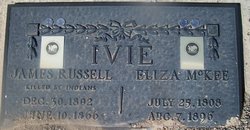
JAMES RUSSELL IVIE & ; WIFE ELIZA MCKEE FAUCETT

Born: December 30, 1802 Born: July 5, 1808
Died: June 10, 1866 Died: August 7, 1861

Sketch of Their Lives By Hettie M. Robins

There is documentary evidence that Ivye, Ivie, Ivy, and Ivey are all of the same family. At the time there were no dictionaries, and the art of spelling was not highly developed. We find that most of the Ivies in the Southern and Eastern states have settled on spelling the name Ivey. We find the Ivey name in the United States as early as 1700. In the Revolutionary War the names of six soldiers are listed from Virginia and nine from North Carolina. In the Civil War there were hundreds, some of them in almost every Southern state and, perhaps, some listed in the Northern States.

Records show a Thomas Ivye or Ivie lived in Gloucestershire, England, about 1425, also of Ives coming to the United States from England as early as 1700, or even before. The above is sort of introductory of the Ivie family, the family tree of which our early grandparents are a branch of James Russell, the son of John Anderson Ivie, who was the sone of Anderson Ivey.

James Russell Ivie, son of John Anderson Ivie and Sarah Allred, daughter of William & Elizabeth Thresher, of North Carolina was born in Franklin County, Georgia, December 8, 1902. He was the second of nine children born to this union.

James Russell married Eliza McKee Faucett. She was born July 5, 1808, at West Columbia, Nuary County, Tennessee, to Richard Faucett and Mary McKee. There were married about June 1824. The location of their marriage is not definitely known, though the belief is that it may have been in Tennessee, since that is where they were living at the time, and their first three children were born, it is evident that they were moving from state to state - - going further west. The family spent from 1830 to 1844 in the State of Missouri, living in Paris, West Paris, and Caldwell Counties. They moved, then, to Council Bluffs, Pottowatamie County, Missouri, where their 11th child was born in 1846. From there they moved to Salt Lake City, where another child was born, and then to Provo, where the next child was born. Thirteen children in all were born to this union.

It was in the early 1830's in Missouri, that the Mormon Missionaries came to the areas in Missouri where the Ivies lived. Parley P. Pratt was one of the elders who came so often to their homes. It was he who brought the Book of Mormon to them and taught them the gospel, which converted them. He also helped to baptize them as members of the Church of Latter-Day Saints. Thereafter, their homes were always homes for the traveling missionaries.

I would like to relate an instance the Great Grandfather told us - - not just once, but many times.

I t happened some years after the Ivies had joined the Church. It was in November 1839, while the Elders were out preaching the Gospel that they were seized and put in prison without a hearing, or a trial. They were held prisoners from November 1839 to July 1940. Among them were Elder Parley P. Pratt, Elder Phelps, and others. The saints had planned a way of freeing the last three missionaries held prisoners. They had been changed from one prison to another during the seven months of confinement. At this time they were in Columbus, Missouri. The plan was worked out as Orson, brother of Parley P. Pratt, and others, had planned it, and happened on the eve of Independence day. The three prisoners, when their evening meal was served, crowded through the door and managed to evade bullets fired at them, and, upon reaching the three horses, brought for them by their brethren, were helped to mount and advised to separate, each going in a different direction, then, to hide themselves, in a deep cave until dark. One of the three was captured and taken back to prison for a short time. Elder Phelps managed to make his escape and reach Illinois, several days later. Elder Pratt was less fortunate and, apparently, headed off in another direction. Finally he made for a vast forest of trees, making his was some distance from his horse to await darkness. He climbed into a huge tree, laid his legs outstretched on top of the branches, locked his arms around two other limbs and, in this way, could not be so easily observed, had anyone come his way. After darkness, when he could no longer hear voices, he came down from his hiding place in the tree and went in search of his horse, which had broken loose and left him to make his way on foot.

On the third day of his escape he found himself in a neighborhood of settlers where he had had some acquaintances years previously, and where once there had been a small branch of the church; but, the saints had moved west, having been driven out of the state with other members of their faith. Elder Pratt remembered there were families of Ivies who had lived on the road, and in some clearing in the timber; so, he decided to make his way to them, and told us, in his own works as follows:

Quote: “ I was not sure if they were still friendly with the church, or if they had turned from it to avoid violence and being driven out. I hesitated, then decided to ask help from my Father in Heaven. I arose to my feet feeling much better. I asked in my prayers, that as I passed by the house, if they were still my friends, I would be recognized - - if not, that I might pass peaceably by. As I walked past their home that Sunday evening, about two hours before sundown, I got nearly by when the children playing in the front yard discovered me and cried out with surprise and much joy: “ There is Brother Pratt.” At this, a young man came running out to me who proved to be one of my acquaintances, still a member of the church, and who had been driven with others from the upper valley. Instead of going to Illinois, he had come back to his old neighborhood. I asked about Mr. Ivy and he said that he and his wife had gone to a neighbor’s home two or three miles away. He said “I am here on a visit.” He also advised that they had just received the news of my escape and were sending out warnings to be on the lookout. I told him of my plight. I was hungry and faint and my feet were covered with blisters. He told me of his brother’s wives and children who were also driven out of upper valley and were living in an obscure place in the woods, while the young man went in to see if it was all right. He came back with milk, cream, and bread. I ate of this and then went to the house. The wife said her husband would soon be home. I told her I was in constant fear of being found. She instructed the children not to say one word if anyone came, but to act like I was a total stranger. It was well she did, for just then a man came inquiring for her husband. She told him he was away and to come back but he said it was a matter of business he wanted to see her husband about and would wait. After an hour the dog barked and they knew her husband was returning. The children rushed out to see their father, and to tell him not to recognize me, as there was a strange young man there to see him. As he came in he gave me a cold look and a “howdy stranger, “ and turned to the other fellow. He was quite friendly with him. The young fellow told the man of the house he had some business with him and would he step out for awhile. He had come to borrow his saddle. As soon as he had gone the man of the house came in and threw his arms around my neck and welcomed me to his house. We ate supper and I asked if he would exchange hats with me as it had been winter when we were arrested. He gave me a hat that fully disguised me. The good wife made a lunch for me and Brother Ivie placed his wife’s saddle on her horse. After farewells to his wife and brother we were soon on our way. He went with me until I was safe - - way after midnight. He bade me God speed and returned to his family.” Unquote

This man and wife were James Russell Ivie and his wife, Eliza. I heard this story many times from Great Grandma and her son, Grandpa Ivie. Only, as I remember it, the side saddle and his horse got him well on his way, but the horse never found his way back.

I remember Grandmother telling: “I would go through the timber to a small spring for a pail of water. I was so frightened - - I could often hear the plaintiff cry of a panther or ‘panter’, as grandmother called it.

James Russell Ivie and Grandmother: Just where they met we don’t know. This is the tale she told, only it has lost its soft southern accent that was so pleasing in the way she would tell it: “I was milking my father’s cow one evening, the first time pop came a‘calling on me. He says, Eliza I’ve come a’ courting you. I looked up and there I saw a boy, plenty big enough to be wearing britches, and there he stood with a doe shirt on. I told him right out if I was to be his girl he better go home and ask his mother to make him some britches. The next time he came he wore britches.” (This was taken from Grandparents’ Martin and Martha Ivie’s family record.) His father John Anderson Ivie, owned a large tract of land, or plantation, and with 75 Negroes on it as slaves. When his son James Russell, and family left to join the saints to come west, his father gave him a little Negro boy. He was old enough to help Grandma with the smaller children. When they reached Omaha and near getting their outfits ready to start out, they were told not to burden themselves with extra mouths to feed, other than their families. So Grandpa, James Russell, gave the little boy his freedom and told him he could go to live with another family, or find his way back to his family. As they left, the little fellow cried and said, “Who will take of Missy, Betsy and Marie, I do love you Mama Ivie.” Both Grandmother and Grandfather loved the Negro boy and hated leaving him behind.

It was in the spring of 1848 in the month of May that the Ivies, James Russell, his wife and nine of their 11 children began plans for moving westward. Two of his sons were with the Mormon Battalion. Besides James Russell and family, two of his brothers, Thomas Isaac, or Kelton, and William Shelton, and families , got as far as Nerrion, Missouri, on their way to joint the wagon train which would have soon headed for the west (Utah). So they dropped out of the company. There was something about one of William’s girls marrying as a plural wife to a man by the name of Long. Both parents strongly opposed the marriage.

It was on the first of June 1948, that the Ivies left Elkhorn in the company of the saints - - 1,229 souls and 397 wagons, headed for the Great Salt Lake Valley. They were in Brigham Young’s second company. The Allred family, also, came at this time. Grandfather’s outfit was well equipped with a good wagon and teams. His son’s Richard’s wife, Elizabeth Dobson, was with them. The trip across the plains and mountains was made about the same as most of them in the company. Great Grandmother helped in cases of sickness and births in their company as well as others, where ever they were needed on their trip to Utah. The pioneers reached Great Salt Lake Valley about September 20, 1848. They must have spent the winter in Salt Lake City, for on February 25, 1849. Grandma gave birth to a son whom they called Hyrum Lewis Ivie. From Salt Lake City they went to what was then called Rhodes, or Roade Valley, and later called Provo Valley. Here another son was born, November 19, 1852. He was named Heber Charles Ivie. Their eighth child, a son, named Joseph Ivie died the year before in 1851. He was 11 years old at the time.

From Provo Valley some of the Ivie family went to Weber County to what is now Kamas. However, they weren’t satisfied with the outlook there, so they left and came to Mt. Pleasant. They had relatives there for a few years. During the time they were in Mt. Pleasant and the time they came to Round Valley (Scipio) in 1863, James Russell and some of his family and the Allred Family, made a trip to Rose Valley, Nevada, with the expectations of locating there. The Valley didn’t meet their expectations - - others having already located there. They came back to Scipio in the late spring of 1863. At that time the settlers were still in Graball or Robinville, where there was a branch of the church, the Ivies didn’t go there to make their home, but went a little further south, up the valley about two miles from Graball. This was where a little stream of water came from a small lake about seven or eight miles further south in the Valley. It separated into two streams. The west stream went by the settlers at Graball, the east stream just running to waste. It was on the east fork that James Russell and family stopped. It was known as Ivie Creek for years. Not long after this, President Young visited the people here, and advised them to locate closer together on a townsite in the Valley. It was called Rourl Valley, but later changed to Scipio.

The Ivies were the first to build homes on the new townsite. The first home built was a room put up of logs - - it was the old stable of the Joe Miller lot, built by William Franklin Ivie, a son of James Russell. His family lived there until he could get logs out to build a place for them to live in. This stable was used to keep a fine stallion in. He had it brought here with the livestock, horse and cattle. Grandfather James Russell built his home and they owned the old Joseph Stone lot - -it is on the northwest corner from the public square. In reading the record kept by the Branch Clerk, John Memmott, we find James Russell Ivie was interested both in his church and civil affairs. Both he and his son, William Franklin, were block teachers, and James Russell was President of the Field Committee, and Water Master. He was also very interested in education. He helped with the loan of his teams to move the log school house from Graball to the new homesite.

In the spring and summer of 1866 the Indians had become very hostile, and on the warpath; making raids on the stock owned by the settlers. A large band of Indians under Chief Black Hawk made a raid on a Sunday Morning, June 10, 1866, when Grandfather James Russell’s favorite milk cow was to freshen. Grandfather rose early and walked down to the pasture lands a little north and west of the settlement, in what was called the pond field. As he neared the spot where the cow was, he heard an Indian War Hoop and the people in town also heard it. They rushed out to look for Grandfather and found his body already pierced by several arrows. He was stripped of his clothing, all but his boots, as they were unable to get them off. The Indians made off with the cattle and horses owned by the families.

Both Grandparents had received their patriarchal blessings. I can remember so well, seeing dear little Grandma going to the old black box, or chest, as she called it. She would reach in, bring out her blessing, hand it to mother, and ask her to read it. It seemed such a source of strength and comfort to her in her last days. The one thing I remember in it, was that their posterity should be as Jacob’s of old, and as numerous as the sands of the sea. Of their 13 children, 12 grew to maturity, marrying, and are parents of large families. A host of grandchildren, some over 125 in number. I am happy to be counted among their great-grandchildren.

History obtained form Loya Moscon, 1888 E. Spring Creek Dr, Bountiful, Utah 84810

My records show that James Russell Ivie is the first born child of Anderson Ivie and Sarah Allred. James Anderson Ivie is the second child of James Russell and Sarah.

I have records of deeds and Anderson Ivie is the name shown on these. F.P.

Hettie M Robins gives us the following description of Eliza M Ivie’s last years.
“After the death of her husband, the care of Eliza fell on the shoulders of her son Martin and his wife, Martha Ivie. Her son moved a one-room log house onto his lot so his mother would be near them. When her son bought a larger home his mother was given a large sunny room to live in. I imagine I see it now with its fireplace and one or two pots hanging from hooks over the flames of coals. There was a very small cook stove in the corner. Her table was next to the fireplace. Just under the window was the large black box or chest that came across the plains with them. Next was the four-poster bed with rawhide stripes crisscrossed for slats or springs. The floor and hearth were scrubbed clean enough to eat on. White short curtains were at the windows The white cover on the black box and cover over the bed pillows all with knotted edging and made out of course white cotton yarn. I remember her telling everyone once that although she was dead and laid out of the cooling board, she said, "But I fooled them, I came back to life again because my mission on earth was not finished." She would sometimes get a little out-of-sorts at some of our pranks and say: "If you youngans  don't behave yourselves when I die I will come back and haunt ye."
"Both Grandparents had received their patriarchal blessings. I can remember so well, seeing dear little Grandma going to the old black box, or chest, as she called it. She would reach in, bring out her blessing, hand it to mother, and ask her to read it. It seemed such a source of strength and comfort to her in her last days. The one thing I remember in it, was that their posterity should be as Jacob's of old, and as numerous as the sands of the sea. Of their 13 children, 12 grew to maturity, marrying and are parents of large families. A host of grandchildren, some over 125 in number. I am happy to be counted among their great-grandchildren."